

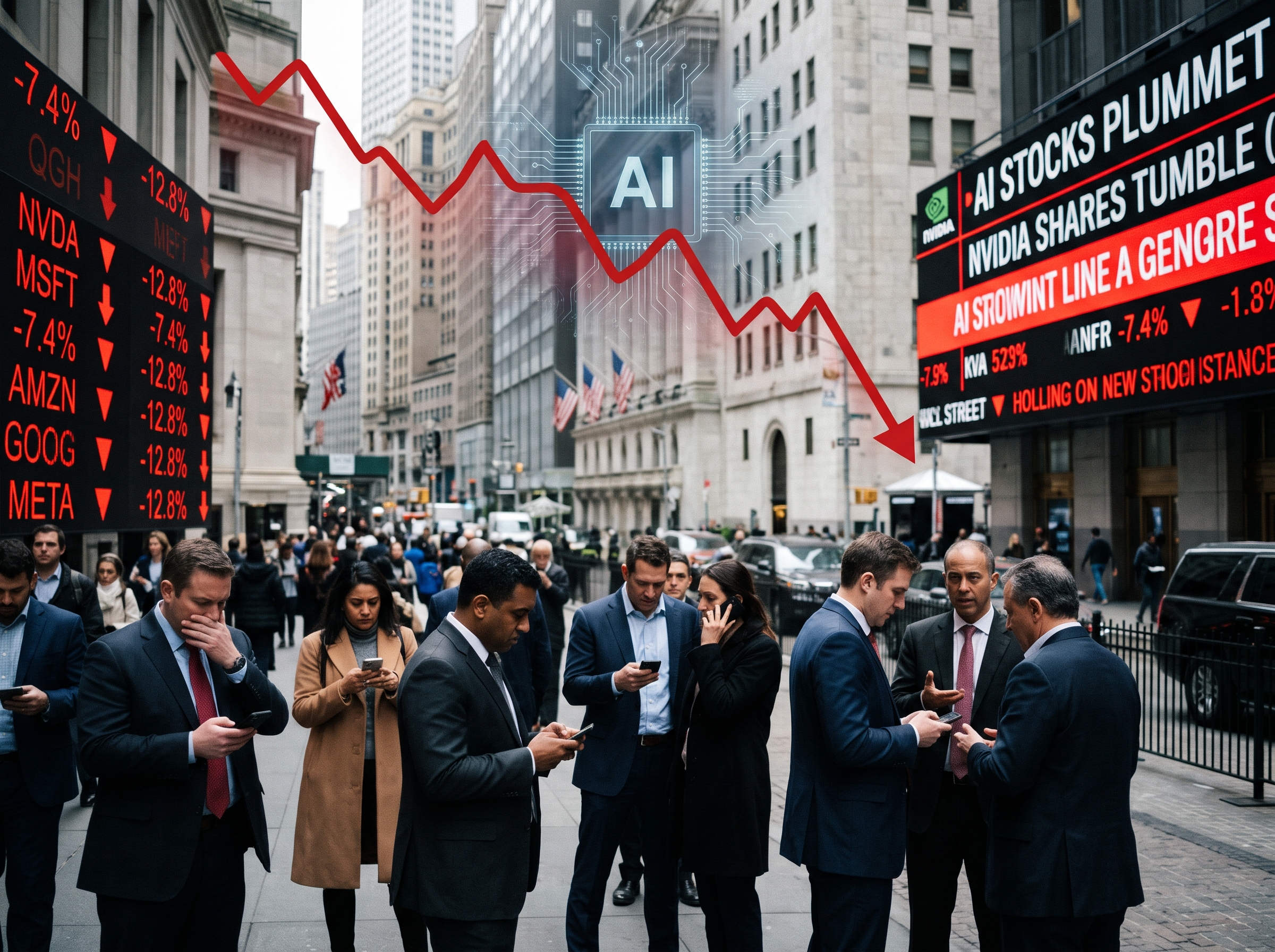
The 2026 AI Market Reckoning: Is the Trillion-Dollar Bubble Finally Bursting?
The integration of Artificial Intelligence into our daily lives has been nothing short of revolutionary. From facial recognition and seamless navigation apps to advanced streaming algorithms and complex healthcare diagnostics, AI is utterly ubiquitous. It even drafts our emails and writes our code. Over the past few years, this technological omnipresence has generated a market valued in the trillions of dollars, transforming Silicon Valley innovators into unprecedented global juggernauts.
However, recent shockwaves on Wall Street are forcing investors, tech enthusiasts, and everyday consumers to ask a highly uncomfortable question: Are we witnessing a temporary market wobble, or is the great AI bubble of 2026 finally poised to burst?
This comprehensive report dives into the recent market turbulence, the vulnerabilities of the tech sector, and what a potential market correction means for the global economy.
The Catalyst: Leadership Crisis at Nvidia
To understand the current market anxiety, one must look at the foundation of the AI boom. No company has powered this explosive growth quite like the US tech giant Nvidia, the primary manufacturer of the advanced computer chips that make modern AI possible. For years, Nvidia's stock trajectory seemed to defy gravity.
Recently, however, the firm’s CEO, Jensen Huang, plunged the company into a historic crisis. Huang admitted to an extramarital affair with Alice Wang, a high-ranking executive at a major data center company. While personal scandals are not entirely uncommon in the corporate world, this specific relationship carries immense geopolitical baggage. US officials have alleged that Wang is a spy for China—a claim that Beijing vehemently denies.
While Huang has issued public apologies and expressed deep remorse for the toll this has taken on his family, Wall Street’s reaction was ruthless and immediate. The mere suggestion of espionage linked to the world’s most critical semiconductor supply chain sent Nvidia’s shares plummeting. It highlighted a stark reality: when a multi-trillion-dollar industry rests on the shoulders of a single company, the personal missteps of one executive can shake the entire global market.
Regulatory Jitters and the 2026 Midterm Shock
The Nvidia scandal did not occur in a vacuum. It struck just days after another major shock to the US market: a sweeping victory for the Democratic Party in the 2026 midterm elections.
For the tech industry, this political shift signaled an immediate threat to their unchecked expansion. Investors have grown highly rattled by the prospect of stricter federal regulations on artificial intelligence development. Furthermore, there are mounting concerns over the massive, energy-hungry data centers required to power these AI systems. Not every community or local government wants these massive facilities in their backyards, and a newly empowered political class may seek to heavily regulate their construction and environmental impact.
Despite these dual shocks, the industry’s momentum has not entirely halted. Anthropic, the company behind the popular AI assistant Claude, is reportedly set to go public this month with a staggering valuation of $1.3 trillion. This astronomical figure comes ironically just months after the company's own leadership warned about the inherent risks of unchecked AI development, perfectly illustrating the profound disconnect between market exuberance and fundamental caution.
The Vulnerability of "Circular Financing"
To separate temporary turbulence from a systemic collapse, financial experts look at the underlying structures of the market. According to insights shared by Robin Wigglesworth, editor of the Financial Times' Alphaville, the defining characteristic of this current stock market mania is its heavy reliance on a remarkably small cluster of mega-corporations.
Unlike the dot-com bubble of the 1990s, which featured hundreds of overvalued internet startups, the 2026 AI boom is heavily concentrated in the hands of a few titans: Microsoft, Alphabet (Google), Amazon, Meta, and Nvidia.
The profound systemic risk lies in how these companies interact. The AI sector is currently propped up by a controversial practice known as "circular financing." These tech behemoths do not operate independently; they are deeply intertwined. They invest in each other's startups, lend capital to one another, and aggressively buy and sell services within their own closed ecosystem.
When an industry relies on circular financing, it becomes a house of cards. It is incredibly difficult for one major player to stumble without sending a catastrophic chill through the rest of the market. These companies are currently borrowing billions of dollars, pounds, and yen—pouring vast sums of money into building data centers before the consumer demand has caught up to the operational costs. In financial terms, if the early years of the AI boom were like having a few casual drinks, 2026 is the year the market brought out the hard liquor.
Will AI Products Disappear for the Consumer?
If this bubble does burst, what happens to the technology we rely on every single day? The short answer is: it isn't going anywhere.
Stock market crashes, while painful for investors, are rarely cataclysmic for the underlying technology. The massive data centers dotting the globe have already been built. The infrastructure is operational, and it will remain operational even if tech stocks drop by 30% or 40%.
However, consumers may notice a shift in pricing. Currently, tech companies are heavily subsidizing AI tools with investor capital to get the public "hooked" on the technology. We are not paying the true economic cost of these services. If the well of investor money dries up due to a market crash, the era of free or dirt-cheap AI access may end. Companies will be forced to ration their computing power, inevitably passing the true costs on to the consumer.
The Macroeconomic Silver Lining
Surprisingly, a deflation of the AI bubble might carry hidden benefits for the broader global economy. In regions spanning from the United States to Europe and the UK, the AI boom has created a lopsided economy.
The relentless drive to build data centers has monopolized construction workers, electricians, and raw materials. This insatiable demand has fueled broader economic inflation, forcing central banks—such as the US Federal Reserve and the Bank of England—to keep interest rates uncomfortably high. Consequently, ordinary citizens and businesses outside the tech sector have been paying the price for Silicon Valley's exuberance through higher mortgage rates and increased borrowing costs.
A mild market correction could blow the dangerous froth off the top of the market. If the frenetic pace of AI investment slows down, it could help cool inflation, eventually allowing central banks to lower interest rates. This would result in a much healthier, more balanced global economy where capital is distributed more evenly across different sectors, rather than being entirely absorbed by the AI hype machine.
Conclusion: Preparing for the Hangover
It is almost inevitable that the market will face a reckoning; the question is not if, but when and how violently the bubble will burst. The dot-com crash of the early 2000s wiped out trillions in market value, yet the foundational companies survived to become today's titans. The AI industry is likely facing a similar crucible.
When financial historians look back in five or ten years, they will likely point to 2026 as the tipping point—the year the valuations became detached from reality, geopolitical scandals shook investor confidence, and the debt-fueled race to build data centers reached an unsustainable peak. The technology will undoubtedly survive and continue to change the world, but for the investors and executives who flew too close to the sun, a severe financial hangover has already begun.


Comments
No comments yet. Be the first to share your thoughts!
Leave a Comment