

The Dawn of a New Semiconductor Era: Decoding the Intel and NVIDIA Mega-Alliance
A Comprehensive Industry Report
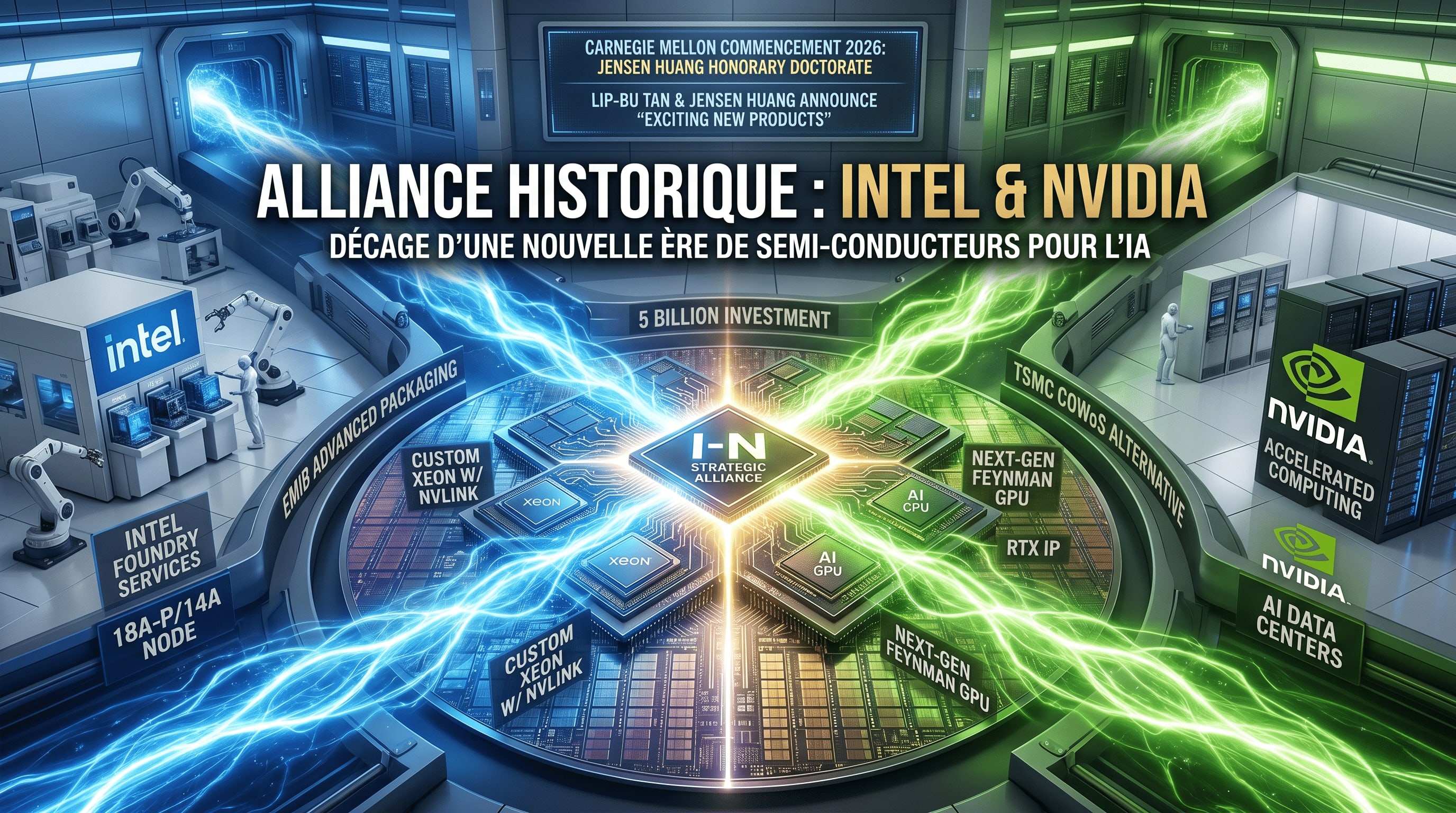
The global technology landscape witnessed a highly symbolic and structurally monumental event in Pittsburgh, Pennsylvania, during the Carnegie Mellon University 2026 Commencement. The ceremony, traditionally a celebration of academic achievement, served as the backdrop for a profound consolidation of power within the semiconductor industry. When Intel Chief Executive Officer Lip-Bu Tan placed the doctoral hood over NVIDIA Chief Executive Officer Jensen Huang, recognizing his honorary Doctor of Science and Technology degree, the gesture represented far more than academic pageantry. It signaled the public crystallization of a deepening, multi-billion-dollar alliance between two historical rivals, fundamentally altering the trajectory of global accelerated computing and artificial intelligence hardware.
This report provides a comprehensive analysis of the expanding Intel-NVIDIA partnership, examining the structural investments, the upcoming product roadmaps across consumer and data center sectors, and the paradigm shift occurring within the global silicon manufacturing supply chain.
The Financial Catalyst: A $5 Billion Strategic Alignment
The foundation of this newfound synergy is rooted in a massive financial commitment. Market analysts have closely monitored NVIDIA’s strategic $5 billion investment into Intel, a decisive move structured to co-develop both data center architectures and consumer-grade computing platforms. Historically, Intel and NVIDIA have competed fiercely across various market segments. However, the exponential demand for artificial intelligence infrastructure has necessitated a shift from pure competition to strategic, synergistic collaboration.
This financial injection acts as a catalyst for joint research and development, ensuring that both tech giants can leverage their respective proprietary technologies to overcome the physical and economic limitations of modern semiconductor design. By pooling resources, Intel and NVIDIA are establishing a formidable moat against competing silicon designers, positioning themselves to capture an unprecedented share of the next-generation computing market.
Revolutionizing the Data Center: Custom Xeon Architecture
The first major technological pillar of this collaboration targets the enterprise and data center sectors. Enterprise artificial intelligence requires immense data throughput and low-latency communication between the central processing unit (CPU) and the graphics processing unit (GPU). To address this, Intel and NVIDIA are co-engineering a custom Xeon processor engineered specifically to feature native NVIDIA NVLink integration.
Currently, data centers rely on complex networking to bridge the gap between Intel's robust server CPUs and NVIDIA's dominant AI accelerators. The integration of NVLink directly into the Xeon architecture eliminates traditional PCIe bottlenecks, allowing for unified memory pools and exponentially faster data transfer rates. This localized, high-speed interconnect will drastically reduce the power consumption and latency of hyperscale data centers, offering cloud providers a highly optimized, turnkey solution for training and inferring complex large language models.
Consumer Innovations: The Promise of Serpent Lake
Beyond the enterprise sector, the consumer computing market is poised for a significant disruption. The collaboration roadmap extends into the development of next-generation System-on-Chips (SoCs), merging Intel's processor manufacturing prowess with NVIDIA's industry-leading graphics IP. The semiconductor industry is currently anticipating the arrival of the "Serpent Lake" architecture, tentatively scheduled for market deployment between 2028 and 2029.
Serpent Lake represents a structural departure from traditional mobile and desktop processor designs. By integrating NVIDIA’s RTX graphics architecture directly onto Intel-fabricated SoCs, the partnership aims to redefine integrated graphics performance. This strategic integration is expected to deliver discrete-level ray tracing, AI upscaling, and advanced rendering capabilities directly onto lightweight, power-efficient platforms. This move is a direct challenge to emerging ARM-based competitors and rival x86 APU manufacturers, aiming to secure total dominance in the premium notebook and mobile computing sectors.
The Foundry Paradigm Shift: Securing the Supply Chain
While the co-development of silicon architectures is highly significant, the most consequential aspect of this alliance lies within the global supply chain, specifically concerning Intel's Foundry Business. For years, NVIDIA has relied almost exclusively on the Taiwan Semiconductor Manufacturing Company (TSMC) for the fabrication of its core data center chips. However, the explosive global demand for AI hardware has exposed critical vulnerabilities in this single-source dependency.
TSMC has faced severe operational constraints, primarily regarding its Chip-on-Wafer-on-Substrate (CoWoS) advanced packaging solutions and overall wafer production capacities. The inability to rapidly scale these highly complex manufacturing processes has created a severe bottleneck for NVIDIA, preventing the company from fulfilling its massive backlog of enterprise orders.
In the search for a secondary, high-volume manufacturing partner capable of meeting these stringent technical requirements, NVIDIA has turned to Intel. Intel’s Foundry Business has recently undergone a massive revitalization, successfully securing high-profile manufacturing contracts, including the TeraFab initiative and crucial fabrication deals with Apple. These recent successes have served as a critical proof-of-concept, providing NVIDIA with the confidence to utilize Intel's geographically diversified fabrication plants to supplement their production output.
Next-Generation Silicon: Feynman and Advanced Packaging
The immediate future of this foundry partnership centers around NVIDIA's highly anticipated next-generation GPU architecture, internally codenamed "Feynman." Industry intelligence indicates that to bypass the TSMC CoWoS bottlenecks, NVIDIA will leverage Intel's proprietary Embedded Multi-die Interconnect Bridge (EMIB) advanced packaging technology. EMIB offers a highly efficient and potentially more scalable method for connecting complex chiplets, which is essential for the massive die sizes of upcoming AI accelerators.
Furthermore, the collaboration extends to the foundational silicon nodes. Supply chain reports suggest that NVIDIA is evaluating Intel's advanced 18A-P and 14A process nodes. While flagship enterprise accelerators may continue to utilize a hybrid manufacturing approach, these advanced Intel nodes are perfectly positioned to fabricate entry-to-mid-tier client products, such as consumer gaming GPUs. This dual-foundry strategy will allow NVIDIA to drastically increase its global output, secure its supply chain against geopolitical uncertainties, and meet consumer demand without sacrificing technological superiority.
Conclusion: A Geopolitical and Technological Realignment
The events at Carnegie Mellon University mark the overt acknowledgment of a tectonic shift in the semiconductor industry. The collaboration between Intel and NVIDIA transcends basic product development; it is a strategic realignment that addresses both the limitations of current computing architectures and the vulnerabilities of the global silicon supply chain. By merging Intel's manufacturing resurgence and CPU dominance with NVIDIA's AI acceleration and graphics expertise, the two companies are forging a comprehensive ecosystem capable of powering the next decade of technological advancement. As the world watches these tech giants converge, the impending product announcements will undoubtedly set a new benchmark for what is possible in the realm of high-performance computing.




Comments
No comments yet. Be the first to share your thoughts!
Leave a Comment