

The Ultimate Weekly AI Edge: OpenAI Images 2.6, Gemini 1.2 Flash, and the Dawn of Space-Based AI
Introduction: Navigating the Evolving Artificial Intelligence Landscape
Welcome to this week’s comprehensive report on the most critical developments in the artificial intelligence sector. As the tech industry continues to push the boundaries of what machine learning and neural networks can achieve, staying updated is essential for developers, digital marketers, and tech enthusiasts worldwide. From Silicon Valley innovations to localized applications in cities like San Diego, this week has brought a fascinating array of software updates, open-weight model releases, and surprising consumer data.
In this detailed breakdown, we will analyze the latest offerings from industry giants like OpenAI and Google, explore the shift toward Answer Engine Optimization (AEO), and examine the real-world adoption rates of AI consumer agents. This report is designed to provide you with actionable insights, respecting the highest standards of Experience, Expertise, Authoritativeness, and Trustworthiness (E-E-A-T).
OpenAI Unveils Images 2.6: Unprecedented Speed and GIF Generation
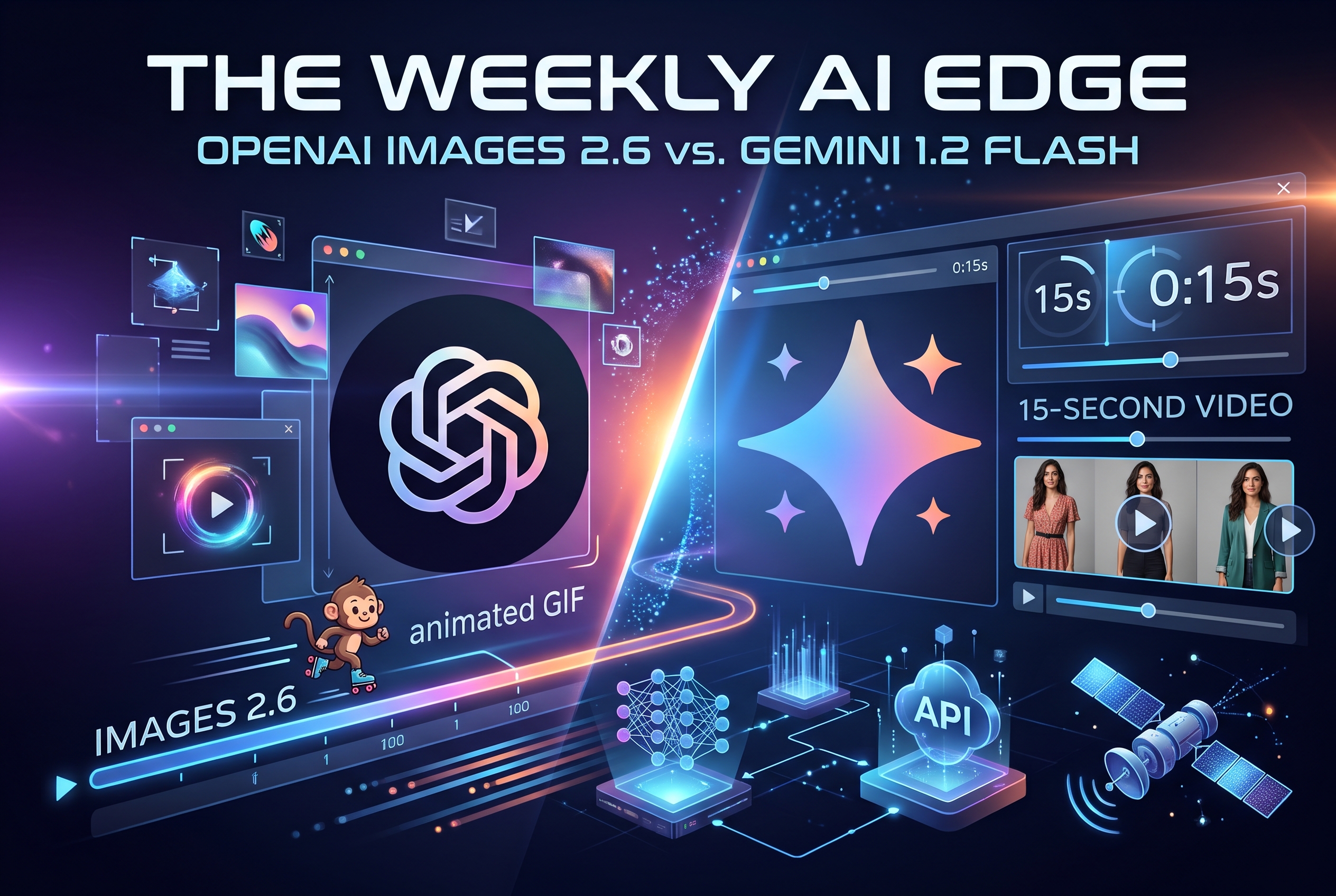
The week kicked off with a major visual upgrade from OpenAI, which officially launched Images 2.6. Available across both the ChatGPT interface and the developer API, this new iteration is explicitly designed to render professional-grade visuals at roughly twice the speed of its predecessor.
However, the standout feature of Images 2.6 is its native ability to generate animated GIFs directly from text prompts. In benchmark testing, prompting the model to create an animated GIF of a monkey roller-skating yielded a high-quality result in under 20 seconds. Furthermore, the model's editing capabilities are highly responsive. When instructed to add a baseball cap to the subject and change the setting from a sidewalk to a street, the model processed the complex editing task—which involves generating and stitching together multiple frames—in under 30 seconds. Standard static image generation is equally impressive, with complex local prompts, such as a sunset over the San Diego skyline with a sailboat, rendering in just over 20 seconds.
Pruna AI’s PH3 Image: A Milestone for Open-Weight Models
In the open-source ecosystem, Pruna AI made waves by releasing the PH3 Image model. By adapting the sophisticated MiniMax H3 video model, Pruna AI has engineered a highly capable, truly open-weight image model. Because the weights are publicly available—hosted directly on Hugging Face—developers can download, fine-tune, and run this model locally, ensuring complete data privacy and customization.
The full 16-bit version of PH3 Image requires a substantial 56 GB of VRAM, making it suitable for high-end enterprise hardware like Apple's M3 or M5 Ultra chips with 128 GB of unified memory, or DGX Spark systems. However, Pruna AI has proactively released 8-bit and 4-bit quantized versions. The 4-bit model requires a much more manageable 21 GB of VRAM, allowing it to run efficiently on consumer-grade GPUs like the RTX 4090 or the upcoming RTX 5090.
The Rise of Answer Engine Optimization (AEO)
The digital marketing landscape is fundamentally shifting from traditional Search Engine Optimization (SEO) to Answer Engine Optimization (AEO). As consumers increasingly rely on generative AI to answer queries rather than scrolling through search engine results, brands must adapt. Platforms like Optimizely are leading this charge by introducing virtual AI teammates. These specialized agents can connect to websites, conduct automated content audits, identify keyword gaps, and provide actionable priority lists to ensure a brand's content is highly visible to AI-driven answer engines.
Google Gemini 1.2 Flash: Expanding Video Capabilities
Google has officially rolled out the Gemini Omni 1.2 Flash video model, bringing significant enhancements to AI video generation. The maximum clip length has been extended from 10 seconds to 15 seconds. Notably, Google has reduced the API cost by 30% compared to version 1.1, bringing the price down to approximately 7 cents per second of 720p video.
The 1.2 Flash model boasts superior reference adherence, meaning it accurately maintains the consistency of specific characters, clothing, and backgrounds across multiple generations. It also features highly realistic voice generation and improved cinematic control. The model is currently accessible via the Gemini API, Google Flow, and Google Vids. In a strong move for consumer adoption, Google is allowing any user with a standard Google Workspace account to generate up to three free 15-second videos per month via the Google Vids platform.
Pika H3 Flex: Pushing the Limits of Video Generation
Adding to the video generation race, Pika Labs announced Pika H3 Flex. This open-weight video model supports resolutions up to 4K and operates at blistering speeds, capable of generating a 15-second clip complete with a synchronized soundtrack in just 7 seconds.
While the capabilities are industry-leading, the hardware requirements are steep. The model size is a massive 220 GB, and achieving the benchmark 7-second generation time requires an 80 GB VRAM H100 GPU. Fortunately, Pika has provided a Hugging Face space where users can test the model for free in the cloud, though generation times may extend to 30 seconds during periods of high traffic.
The Evolution of Voice Agents: Meta Muse and Grokbot
Conversational AI is moving rapidly beyond text. Meta has updated its Muse model to support both voice and video calls. Users can interact with a virtual avatar, customize the agent's voice pitch and tone, and command it to manage Gmail, review calendars, or generate social media content ideas entirely hands-free.
Similarly, xAI’s Grokbot has introduced a feature allowing the AI to make outbound phone calls on behalf of the user. In real-world tests, the agent was able to call a local retail store, engage with a human employee, and accurately inquire about operating hours. While the technology is functional, industry analysts note that there is still a high probability of humans hanging up once they realize they are speaking to a robotic assistant, indicating that societal acceptance of AI phone agents is still in its infancy.
Anthropic’s Claude Enters Financial Tech
Anthropic has introduced a significant new feature for its Claude Pro, Max, and Ultra subscribers: secure bank integration. Utilizing the Plaid protocol, users can now grant Claude read-only access to their financial data. This allows the AI to act as a personal financial analyst, categorizing expenses, calculating remaining budgets before the next payday, and tracking spending habits. Anthropic strictly adheres to privacy standards, ensuring that financial data is never used to train its models and that full account numbers remain masked.
Consumer Adoption Reality Check: AI for Deliveries
Despite the rapid advancement of AI agents capable of ordering food or booking rides, real-world consumer adoption remains surprisingly low. Recent Q3 earnings reports provided a stark reality check. DoorDash, which processes an average of 3 million deliveries daily, reported that only a few hundred orders in total have been placed via AI agents. Uber echoed this sentiment, revealing that out of 320 million recent trips, a mere 500 were booked using AI assistants. The data suggests that while the technology exists, consumers are not yet comfortable or motivated enough to hand over daily logistical tasks to artificial intelligence.
Project Sun Catcher and the Slower News Cycle
In groundbreaking hardware news, Google’s Project Sun Catcher—a prototype satellite designed to operate TPUs and GPUs in space—achieved its "Hello World" milestone this week. By successfully processing AI requests from orbit and transmitting the data back to Earth, Google has proven the viability of space-based AI data centers.
Despite these incredible technical milestones, industry insiders have noted a slight slowdown in massive, paradigm-shifting announcements. Market analysts attribute this temporary deceleration to macroeconomic factors, including the uncertainty surrounding the recent US elections, corresponding stock market fluctuations, and anticipation of Anthropic’s impending IPO. Tech giants like OpenAI are likely strategizing their next major releases to coincide with or disrupt competitor timelines, leading to a quieter, more calculated period in the AI sector.
As the industry stabilizes post-election, we can expect the pace of innovation to accelerate once again. Until then, the focus remains on refining existing models, optimizing for Answer Engines, and pushing the limits of open-weight technology.
Comments
No comments yet. Be the first to share your thoughts!
Leave a Comment