

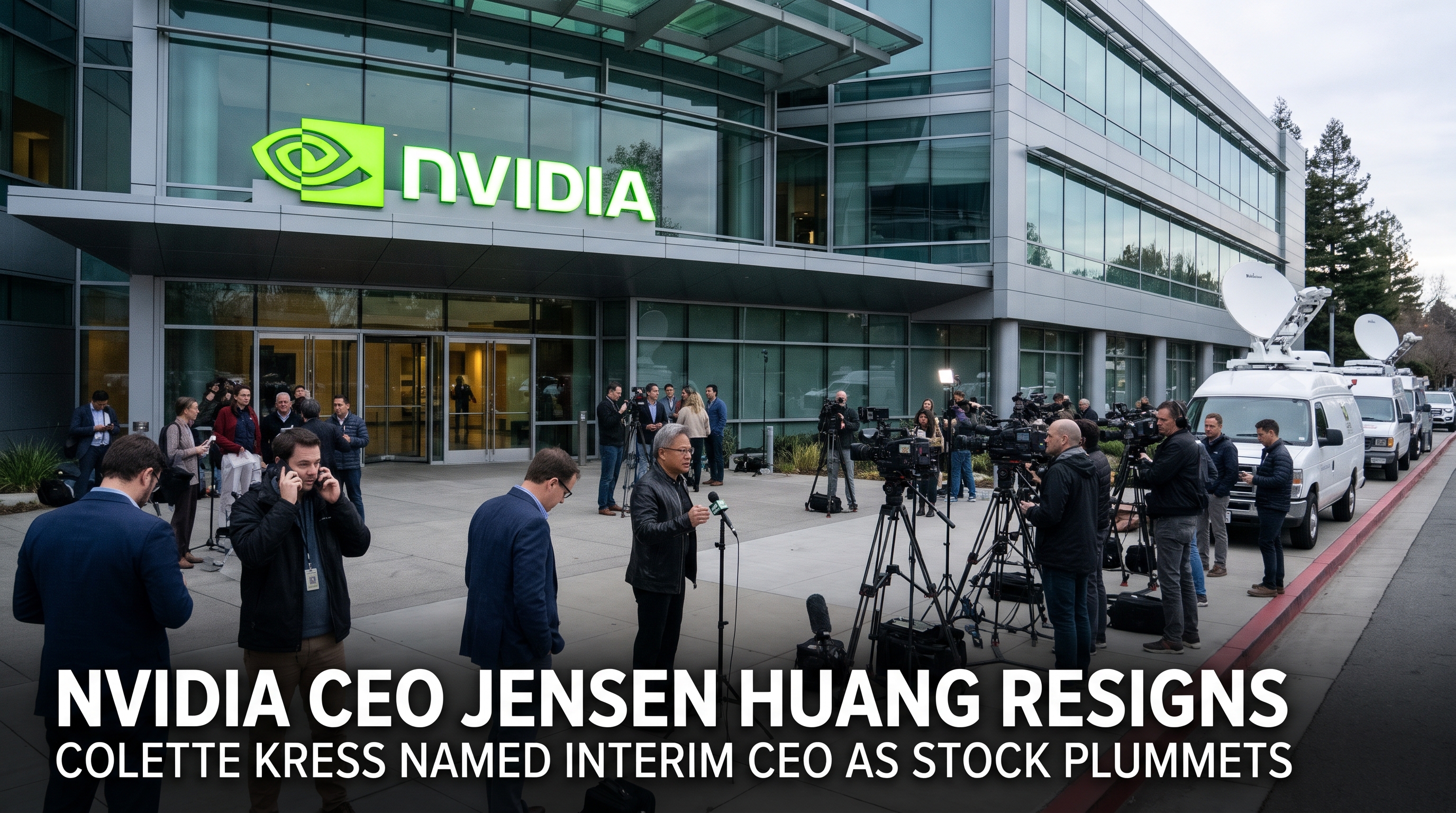
A Seismic Shift in Silicon Valley: Analyzing Jensen Huang’s Resignation from Nvidia and the Future of the AI Boom
Executive Summary:
- Jensen Huang has abruptly resigned as CEO and President of Nvidia amid a national security controversy involving an alleged Chinese intelligence operative.
- Colette Kress, Nvidia’s current CFO, steps in as interim CEO while newly appointed Board Chair Harvey C. Jones leads the search for a permanent successor.
- The announcement triggered a massive market sell-off, erasing over $855 billion from Nvidia’s market capitalization in a matter of days.
- Huang’s departure casts uncertainty over Nvidia’s sprawling financial ecosystem, which includes $99 billion in direct AI investments and complex neocloud credit guarantees.
- The semiconductor industry now faces unprecedented volatility as investors await Nvidia’s upcoming Tuesday earnings call for critical forward-looking guidance.
The technology sector is reeling following the unprecedented announcement that Jensen Huang, the visionary founder and long-standing CEO of Nvidia, has resigned. Confirmed via a regulatory filing late Wednesday, the departure concludes a historic 33-year tenure that transformed a struggling graphics chip startup into the undisputed backbone of the global artificial intelligence revolution.
However, the circumstances of his exit have cast a long, dark shadow over the company’s immediate future. Huang’s resignation comes just days after his admission of a romantic involvement with an alleged Chinese spy. In an era where advanced semiconductors are treated as critical geopolitical assets, this revelation has ignited a U.S. national security crisis, prompting immediate intervention by Nvidia's board of directors.
As the dust begins to settle, the global tech ecosystem is left grappling with a critical question: Can the AI boom sustain its momentum without its most vocal and influential architect?
The Financial Fallout and Interim Leadership
The market’s reaction to Huang’s departure was both immediate and brutal. In early morning trading on Thursday, Nvidia’s shares plummeted by nearly 12%. When factoring in the turbulence that began late last week, the company’s stock has contracted by as much as 19%. To put this into perspective, this sell-off has resulted in a staggering market capitalization loss of more than $855 billion—a sum larger than the total valuation of most Fortune 500 companies.
To stabilize the ship, Nvidia’s board has named Colette Kress, the company’s current Chief Financial Officer and Executive Vice President, as interim CEO. Kress, a seasoned executive who will also retain her CFO duties, represents continuity in Nvidia’s financial strategy. Furthermore, the board has appointed Harvey C. Jones—a managing partner at Square Wave Ventures and a board member since 1993—as its first-ever Chair of the Board of Directors. Jones will now shoulder the monumental task of finding a permanent successor.
Finding that successor will be incredibly complex. Unlike many Silicon Valley titans, Huang did not possess supervoting rights; he was the largest individual shareholder at roughly 3.5%, meaning he served at the pleasure of the board. Yet, he governed Nvidia with a notoriously flat organizational structure featuring roughly 60 direct reports and no clear heir apparent, making a seamless transition highly unlikely.
The Architect of the Generative AI Era
To understand the magnitude of this leadership vacuum, one must examine Huang’s legacy. Founding Nvidia in 1993, Huang navigated the company through early existential struggles to pioneer the Graphics Processing Unit (GPU). Initially designed to render complex graphics for PC gaming, the GPU’s architecture proved exceptionally adept at parallel processing—handling thousands of calculations simultaneously.
By 2006, Huang made a prescient, multi-billion-dollar gamble by launching the CUDA architecture. This software layer allowed developers to utilize GPUs for general-purpose computing. When AI researchers discovered that these parallel processing capabilities were perfect for training neural networks, Huang ruthlessly pivoted the entire company toward data centers and artificial intelligence.
The financial results of this pivot are nothing short of historic. Before the launch of ChatGPT sparked the current generative AI frenzy, Nvidia shares traded near $15. By last month, they had surged over 1,450% to an all-time high of $243, pushing the company’s market cap to an eye-watering peak of $5.88 trillion in early October. Revenue skyrocketed by over 1,500%, moving from $5.93 billion in Q3 2023 to $96.22 billion by the second quarter of this year. Profits followed suit, expanding nearly 88-fold to hit $59.69 billion as of July 2026.
A Geopolitical Crisis at the Worst Possible Time
The controversy triggering Huang’s resignation arrives at a highly sensitive geopolitical juncture. Nvidia’s GPUs are not merely commercial products; they are the engines powering advanced military and strategic AI systems.
China has historically been a massive market for Nvidia. However, its contribution to the company’s bottom line has contracted in recent years, accounting for roughly 8% of total revenue ($7.9 billion) in the second quarter. This decline is largely the result of strict U.S. export controls and Beijing’s aggressive push for domestic semiconductor sovereignty.
Huang had been an active political force, aggressively lobbying Washington—and cultivating relationships across political administrations—for looser regulations on the export of high-power AI chips. The revelation of an affair with an alleged Chinese intelligence operative compromises those lobbying efforts entirely, raising severe national security concerns about potential intellectual property vulnerabilities and strategic compromises.
The Ecosystem Contagion: Investments and Neoclouds
Perhaps the most pressing concern for Wall Street is the sprawling financial ecosystem Nvidia has engineered under Huang’s leadership. Nvidia is not just selling shovels in the AI gold rush; it is financing the miners.
As of its latest quarter, Nvidia reported $99 billion in venture investments and another $25 billion in commitments. The company has essentially acted as a central bank for the AI industry, holding $36 billion in cloud service commitments. Under these arrangements, Nvidia helps AI cloud operators finance the purchase of its own GPUs, agreeing to buy compute power back from them to support the ecosystem.
Nvidia has heavily backed "neoclouds"—startups dedicated purely to AI processing. Recent investments include $2 billion into CoreWeave, $2 billion into Nebius, and potential credit guarantees for Nscale’s massive West Virginia data center project. This is alongside a staggering $105 billion credit guarantee framework for an OpenAI data center campus in Ohio, a $30 billion direct investment in OpenAI, $10 billion in Anthropic, and $3.5 billion in MediaTek for custom AI chip development.
Huang’s exit introduces massive uncertainty into this highly leveraged architecture. Investors were already growing anxious about the immense debt raised to sustain this infrastructure buildout. The immediate market contagion reflects this fear: CoreWeave’s shares dropped 9% on Thursday, Nebius plunged 16%, and IREN fell 6.6%.
Looking Ahead
As the industry grapples with the fallout, all eyes are locked on next Tuesday, when Nvidia is scheduled to report its quarterly earnings. The conference call will serve as the market's first real test of interim CEO Colette Kress and Board Chair Harvey C. Jones.
They will need to provide extreme clarity on three fronts: the integrity of their intellectual property in light of the espionage allegations, the status of their massive ecosystem investments, and the roadmap for restructuring a company uniquely molded in the image of a single, irreplaceable founder.
Nvidia’s chips have fundamentally reshaped modern computing, but the company must now prove that its foundation is strong enough to survive without the architect who built it.




Comments
No comments yet. Be the first to share your thoughts!
Leave a Comment