

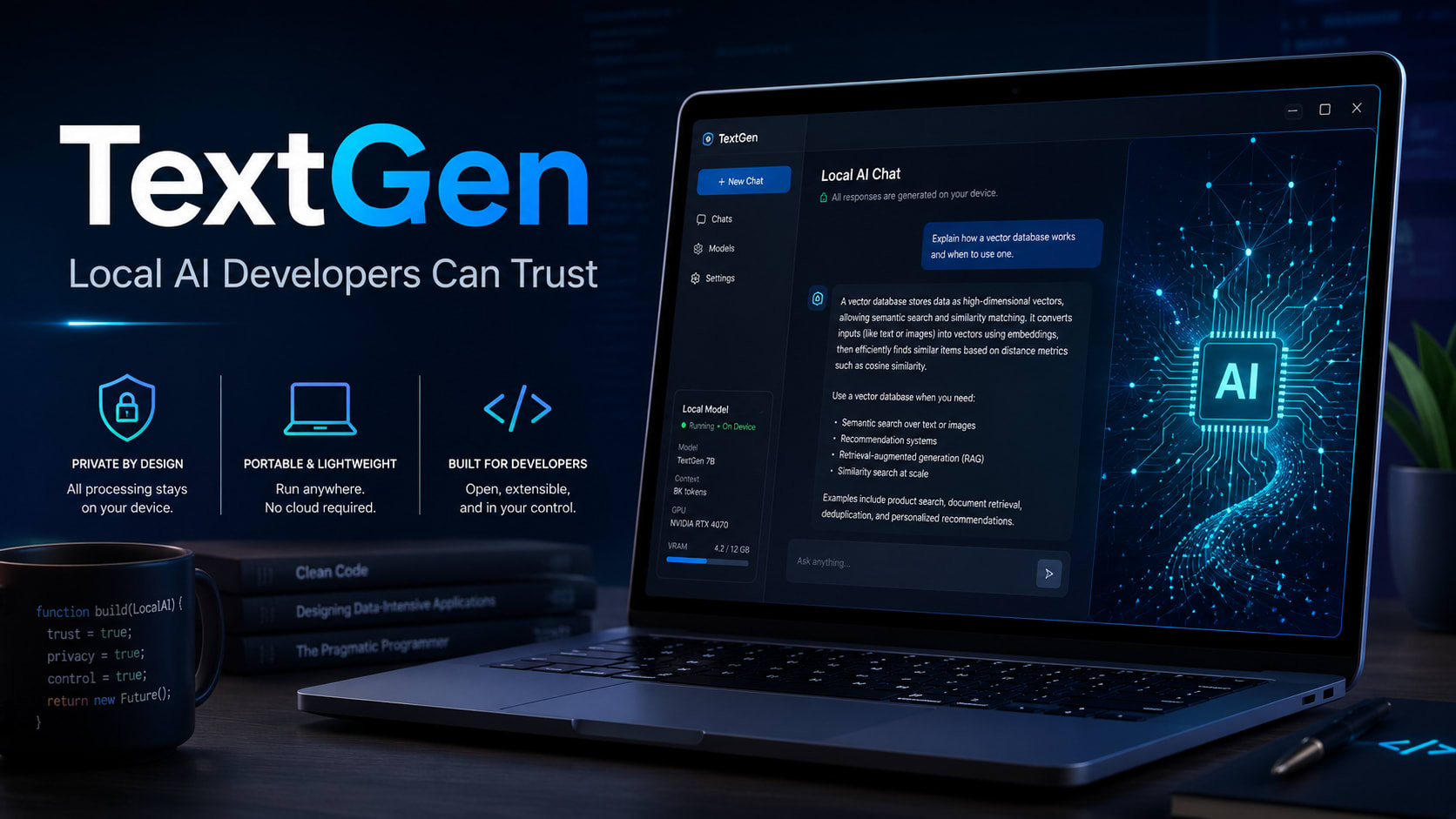
TextGen Turns Local AI Into a Trusted Desktop App
Local artificial intelligence is entering a new phase. For the past few years, the conversation around local large language models has focused heavily on performance, model size, quantization, GPU memory, and whether ordinary machines can run useful AI at all. That question is no longer theoretical. Developers, researchers, founders, and privacy-conscious users already know that local LLMs can be useful. The more important question now is whether local AI tools can become reliable products rather than experimental weekend projects.
TextGen, formerly known as text-generation-webui, is one of the clearest signs of that shift. The project associated with oobabooga has moved from being remembered mainly as a powerful web interface for local LLM enthusiasts into a no-install desktop application designed for Windows, Linux, and macOS. According to the provided source text, TextGen is now positioned as a desktop app that users can unzip and run without a traditional installation process, bringing it closer to the product category occupied by LM Studio while keeping its open-source identity.
That change may sound like a packaging update, but it represents something larger. In local AI, installation friction has always been one of the biggest barriers between technical possibility and everyday use. A tool can support excellent models, advanced parameters, and powerful backends, but if users must fight Python versions, dependency conflicts, GPU drivers, unclear launch scripts, and cryptic terminal errors, only a narrow group of enthusiasts will stay committed. TextGen’s desktop direction suggests that the local AI ecosystem is beginning to understand what mainstream developer adoption really requires: stability, clarity, privacy, and a user experience that feels like software, not a research demo.
The project’s GitHub page describes TextGen as an open-source desktop app for local LLMs with support for text, vision, tool-calling, and OpenAI or Anthropic-compatible APIs. It also emphasizes offline use and zero telemetry, which directly addresses a growing concern among developers who want local AI not only for cost control, but also for data privacy and trust.
Why TextGen’s Desktop Shift Matters
Local AI has already proved that consumer and workstation hardware can run useful models. The challenge now is usability. A founder may want to prototype a private customer-support assistant. A developer may want to test an OpenAI-compatible local endpoint. A small legal or finance team may want to summarize internal documents without sending sensitive information to a third-party service. In all of these cases, the value of local AI depends not only on model quality, but also on whether the tool can be set up and used without wasting hours.
This is where TextGen’s new form matters. The release page for TextGen highlights portable builds and describes the experience simply: download, unzip, and double-click. It also includes hardware-specific build options, including CUDA-related builds for NVIDIA users and other options designed to support different local setups.
For developers, this kind of packaging matters because it reduces the gap between experimentation and real workflow integration. A local LLM interface is no longer just a chat window. It can become a testing environment, a local API server, a prompt evaluation space, and a bridge between open-weight models and production-style applications. When a tool supports familiar API patterns, developers can build against local models first and later decide whether to deploy with cloud AI, local infrastructure, or a hybrid approach.
Privacy Is Becoming a Product Feature
The privacy argument for local AI is simple but powerful: if inference happens on the user’s machine, prompts and files do not need to leave that environment. But in 2026, users are asking more sophisticated questions. They do not only want to know whether the model runs locally. They also want to know whether the application collects analytics, checks remote services, phones home, or hides important behavior behind closed binaries.
TextGen’s public positioning leans directly into this trust issue. Its GitHub page describes the app as offline and private, with zero telemetry, external resources, or remote update requests. That is an important claim in a market where AI tools often require accounts, cloud connections, usage tracking, or opaque hosted pipelines.
For professionals handling confidential material, privacy is not a marketing slogan. It can be a requirement. Startups may want to test product ideas using proprietary data. Developers may want to debug code without exposing internal repositories. Writers, analysts, and consultants may want to process client documents locally. In these scenarios, local-first AI tools can offer a practical middle ground between avoiding AI entirely and sending everything to hosted platforms.
However, privacy alone is not enough. A local AI tool also has to be usable. The strongest products in this category will be those that combine local control with a polished workflow. TextGen appears to be moving in that direction by improving its interface, release packaging, and developer-facing compatibility.
Competing With LM Studio on More Than Models
LM Studio has become one of the most recognizable desktop tools for running local LLMs because it makes model discovery, chatting, and local serving approachable. Its official positioning focuses on running models locally and privately, while also offering developer features such as local server capabilities and OpenAI-compatible workflows. The broader local AI market has rewarded tools that reduce complexity and make users feel in control.
TextGen is now entering that same product conversation, but with a different identity. It is not simply trying to be another polished local AI app. Its advantage comes from being open source, long-running, and deeply familiar to the local LLM community. The Reddit announcement from oobabooga describes TextGen as formerly text-generation-webui and frames it as an open-source alternative to LM Studio.
That distinction matters. Developers often care about inspectability. They want to know what code is running, how APIs behave, how model loading is handled, and whether a tool can be adapted to their needs. An open-source desktop AI app gives technical users more confidence, especially when the tool is being used for private workflows or internal experimentation.
Still, TextGen’s opportunity also comes with a challenge. Mainstream users do not reward tools simply because they are open source. They reward tools that work reliably. If TextGen wants to become a trusted desktop product, it must keep improving documentation, onboarding, error handling, and interface design. Local AI users may forgive rough edges during early experimentation, but professional users expect a product that behaves predictably.
A Better Path for Developers and Small Teams
For developers and small teams, TextGen’s evolution points to a practical future. Local AI does not need to replace hosted AI services entirely. Instead, it can become a private development layer. Teams can use local models to test prompts, evaluate workflows, compare model behavior, and build prototypes before committing to cloud infrastructure or paid APIs.
This is especially useful for teams working under budget constraints or privacy restrictions. Hosted AI is often powerful, but costs can grow quickly when teams experiment at scale. Local LLMs allow repeated testing without every prompt becoming an API expense. They also give developers more control over latency, model selection, and data handling.
TextGen’s support for local model workflows, tool-calling, and API compatibility makes it relevant beyond casual chat. If a developer can use a local tool in a way that resembles production AI interfaces, the desktop app becomes part of the engineering workflow. It becomes a sandbox for serious work.
The Local AI Market Is Maturing
The larger story behind TextGen is the maturation of local AI. The first phase was about proving that open-weight models could run on personal hardware. The second phase was about expanding model formats, quantization methods, and backend performance. The current phase is about trust, usability, and product design.
TextGen’s latest direction shows that open-source AI tools are adapting to this reality. A strong feature list is no longer enough. The winners in local AI will be the tools that make private, offline, developer-ready AI feel dependable. Users want fewer setup obstacles, clearer interfaces, better hardware support, and transparent privacy practices.
TextGen is not guaranteed to dominate this space. LM Studio, Ollama, GPT4All, LocalAI, and other tools all serve different audiences and workflows. But TextGen has an advantage that many competitors do not: a long development history, a large technical community, open-source credibility, and now a desktop product shape that feels more accessible.
Final Analysis
TextGen’s transformation from text-generation-webui into a no-install desktop application is more than a rebrand. It reflects a broader change in the local AI ecosystem. Developers no longer want local LLM tools that merely function after enough troubleshooting. They want tools they can trust, inspect, and use repeatedly in real workflows.
By combining portability, privacy, API compatibility, and open-source transparency, TextGen is positioning itself as a serious option for developers who want local AI without giving up control. Its future success will depend on whether it can maintain the power that made it popular with enthusiasts while becoming simple and reliable enough for broader professional use.
For now, the signal is clear: local AI is moving out of the workshop and onto the desktop. TextGen’s desktop turn shows that the next competition in AI will not only be about who has the biggest model. It will also be about who can make private, local intelligence feel trustworthy enough to use every day.



Comments
No comments yet. Be the first to share your thoughts!
Leave a Comment