

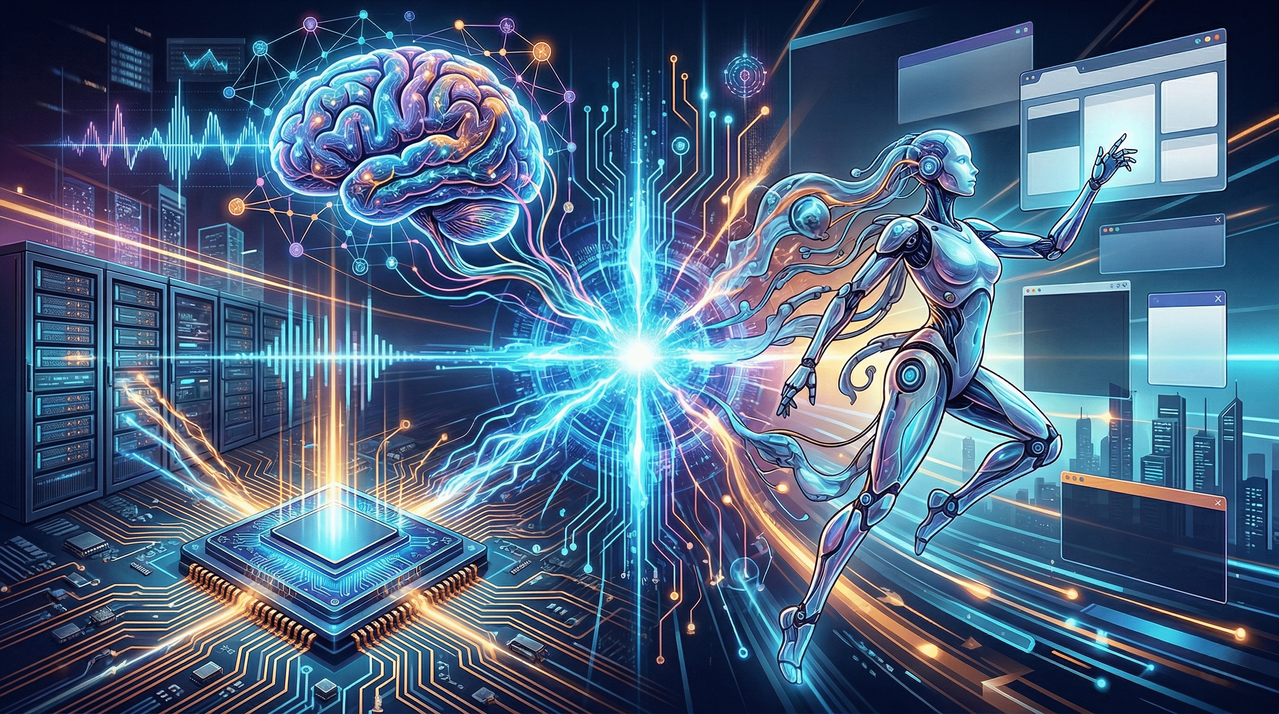
The Big AI Leak and the Rise of "Mind-Reading" Models: A Wild Week in Tech
If you thought the AI news cycle was finally starting to slow down as we move through early 2026, think again. This week felt like a decade squeezed into seven days. From massive accidental leaks at Anthropic to Meta literally trying to map the human brain, the landscape is shifting from "chatbots that write poems" to "agents that actually do the work."
Grab a coffee—we’ve got a lot to unpack. Here is everything you need to know about the Anthropic Mythos leak, Meta’s Tribe V2, the self-evolving Gwen Claw, and Alibaba’s latest silicon power play.
1. The Anthropic "Oopsie": Meet Claude Mythos
Let’s start with the drama. We’ve all made mistakes at work—maybe you replied-all to a company-wide email or forgot to mute yourself on Zoom. But Anthropic just had a "classic internal mistake" that resulted in leaking their most powerful model to date.
What Happened?
A CMS (Content Management System) configuration error left a data cache publicly accessible. We aren’t talking about a single PDF, either. Over 3,000 assets were exposed, including internal documents, employee files, and a draft blog post for a model called Claude Mythos (internally referred to as Capiara).
Why Mythos Matters
Right now, Anthropic uses a three-tier system: Haiku (fast), Sonnet (balanced), and Opus (powerful). Mythos represents an entirely new class of model sitting above Opus.
- The Power Jump: Anthropic describes it as a "step change" in performance.
- The Focus: Major improvements in reasoning, complex coding, and—most notably—cybersecurity.
- The Warning: The leaked documents suggest Mythos is far ahead of any other AI in "cyber capabilities." It can find and exploit vulnerabilities faster than human defenders can patch them.
Because of these risks, Anthropic isn't doing a wide public release yet. They are working with early access customers and cybersecurity teams to "prepare the world" for what this model can do. They’ve already seen state-linked groups use their current models to target financial and tech institutions, so the caution here isn't just PR—it's a necessity.
2. Meta’s Tribe V2: AI is Learning to Read Your Brain
While Anthropic is busy building "The Brain" of AI, Meta’s FAIR (Fundamental AI Research) team is trying to figure out how your brain works. They just introduced Tribe V2, and it sounds like something straight out of a sci-fi thriller.
The Goal: Universal Brain Prediction
For decades, neuroscience has been fragmented. One lab looks at how we see colors; another looks at how we process speech. Meta is trying to unify this. Tribe V2 is an AI system designed to predict exactly how a human brain will respond when watching a video, hearing a podcast, or reading a book.
How They Built It
Meta didn't just build a new model; they "Frankensteined" their best existing tools:
- Llama 3.2 for text.
- V-JEPA for video.
- Wav2Vec for audio.
They trained this monster on over 451 hours of fMRI data from people watching movies and listening to stories. They then tested it on over 1,100 hours of data from 720 different people.
The Results are Slightly Terrifying
The most impressive part? Zero-shot prediction. Tribe V2 can predict the brain activity of a person it has never seen before. In many cases, the AI’s "guess" at how a group of people would react was more accurate than the actual recordings from individual subjects.
Meta calls this "in-silico neuroscience." Essentially, they can now run virtual brain experiments on a computer without needing a human to sit in an MRI machine for hours. It recovered classic brain landmarks like the Broca’s area (language) and the fusiform face area (faces) perfectly.
3. Gwen Claw: The Agent That Actually Finishes the Job
If you’ve ever used an AI agent, you know the frustration. They start strong, but the moment you change a detail or ask for a revision, they "reset" or get lost in the weeds.
Enter Gwen Claw, a new self-evolving agent from the open GWN community. Its mission isn't to be the most "chatty" or "human-like" AI—it’s to be the most effective executioner.
Three-Layer Memory
Gwen Claw uses a sophisticated memory system to stay on track:
- Stable Identity Layer: Who is the agent and what are its core rules?
- Long-term Background Layer: The history of your project.
- Dynamic Trajectory Layer: What is happening right now in the task?
Real-World Integration
Unlike other agents that live in a "clean" demo browser, Gwen Claw takes over your local browser environment. This means it can use your real cookies, login states, and cached data. It doesn't get stuck on login screens or bot-detection pop-ups because it operates as you.
It Learns from Failure
This is the "human" signature of the project. Most AIs are static. If they fail, they fail the same way every time. Gwen Claw has a self-evolution loop. If it hits a wall, it logs the failure, analyzes the root cause, and optimizes its approach for the next attempt. It literally gets smarter the more you use it.
4. Alibaba’s XuanTie C950: The Silicon Response
Finally, let’s talk hardware. While the world is obsessed with Nvidia’s GPUs, Alibaba is making a play for the CPU market with the XuanTie C950.
Why a CPU for AI?
We usually use GPUs to train models, but inference (running the model) is a different story. AI agents perform multi-step, sequential tasks. CPUs are naturally better at this kind of "thinking in a line" than GPUs.
The RISC-V Advantage
The C950 is built on RISC-V, an open-source architecture. This is a massive strategic move for Alibaba. Because of US export restrictions on advanced chips, Chinese firms need domestic alternatives. By using RISC-V, Alibaba avoids paying royalties to Western companies like ARM and gains total control over their supply chain.
Alibaba claims the C950 offers a 30% performance boost over mainstream competitors for agent-based workloads. They aren't selling these chips to the public; they are using them to power their own cloud services, making their AI faster and cheaper than the competition.
Final Thoughts: The Shift to "Heavy" AI
If there is one takeaway from this week, it’s that the "toy" phase of AI is over.
We are moving into an era of "Heavy AI." We have models like Mythos that are too dangerous for wide release, Tribe V2 that can simulate human thought, Gwen Claw that can navigate the messy real-world web, and custom silicon like the C950 designed to run it all.
The gap between "having a conversation with an AI" and "having an AI do your job" is closing faster than anyone predicted.
What do you think? Are you more excited about an AI that can finish your Excel work, or more worried about a model that can outpace cybersecurity experts? Let’s talk in the comments.
Stay tuned for more updates as we continue to track the evolution of the Capiara/Mythos rollout.


Comments
No comments yet. Be the first to share your thoughts!
Leave a Comment