

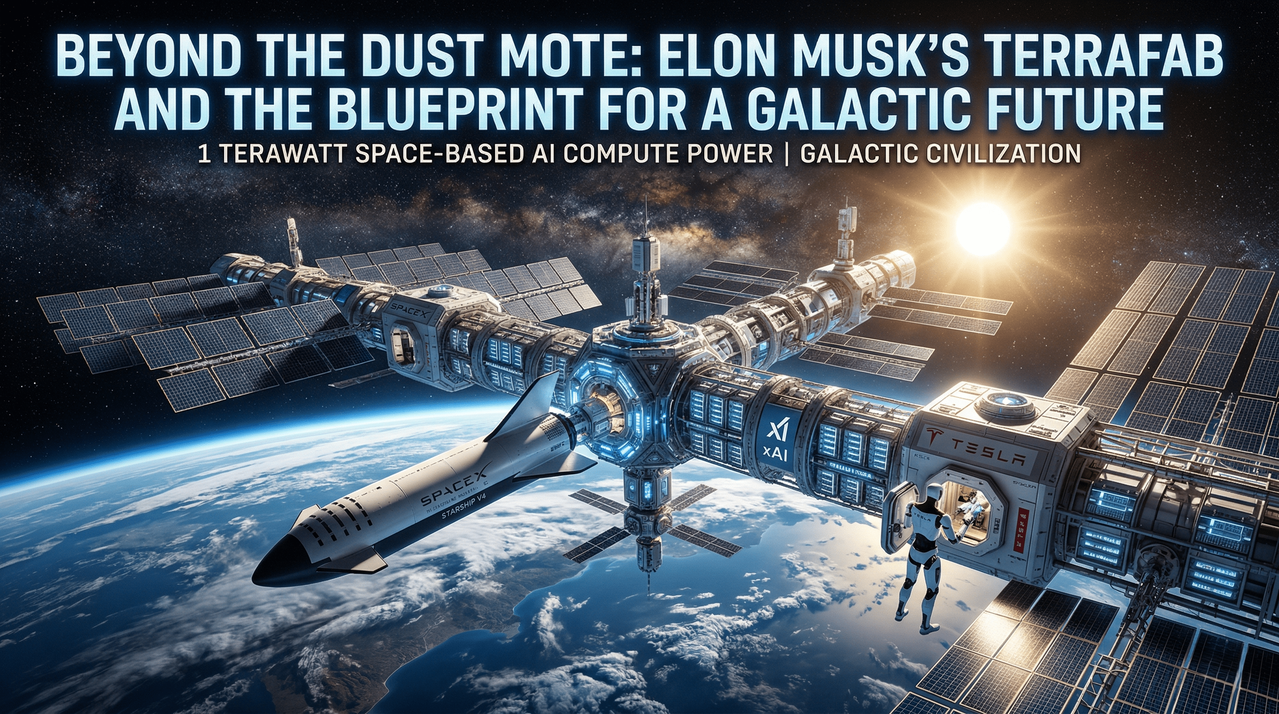
Beyond the Dust Mote: Elon Musk’s TerraFab and Our Galactic Blueprint
We’ve all heard Elon Musk talk about Mars, but his latest drop regarding the "TerraFab" takes things to a level that feels less like a corporate keynote and more like the opening chapter of a high-stakes sci-fi epic.
If you’ve been following the recent talk, it’s clear we aren't just talking about better GPUs or faster cars anymore. We’re talking about the fundamental architecture of a galactic civilization. Let’s break down what this means for us, the "miscellaneous" inhabitants of a tiny dust mote.
From Science Fiction to Science Fact
Musk kicked things off by tapping into our collective imagination—referencing legends like Asimov, Heinlein, and Iain M. Banks. The goal? To turn the "exciting future" of Star Trek into reality.
But to get there, we have to solve a math problem that most of us overlook: Energy. According to the Kardashev scale, we aren't even a "Type 1" civilization yet. We use a tiny fraction of the energy that hits our planet. In fact, Musk reminded us that Earth only receives about half a billionth of the sun’s energy. To scale civilization, we have to scale power in space.
The Power Trio: SpaceX, xAI, and Tesla
The "TerraFab" isn't just one building; it’s a symbiotic collision of Musk’s three giants:
- SpaceX: The logistics arm. To get to a Terawatt of compute, we need to put 10 million tons of payload into orbit per year. Thanks to Starship V3 and V4, that’s actually becoming a "no-physics-violated" reality.
- xAI: The brain. They’ve already built the first gigawatt-scale cluster in record time (even Nvidia’s Jensen Huang was impressed).
- Tesla: The hardware and robotics. Between the Optimus robot and the new "Advanced Technology Fab" in Austin, Tesla is moving toward a recursive loop—designing, masking, and testing chips all under one roof.
Why the Future of AI is "Always Sunny"
One of the most provocative points in the talk was the argument for Space-Based AI. Why send chips into the void?
- Efficiency: In space, it’s "always sunny." No clouds, no night cycle, no atmospheric interference. Solar power is 5x more effective there.
- Cost: Musk predicts that in just 2 or 3 years, it will be cheaper to run AI in space than on Earth. Why? Because on Earth, we’re running out of "easy spots" to build power plants, and nobody wants a massive reactor in their backyard (NIMBY is real, folks).
- Heat: While people argue about radiators, SpaceX has 10,000 satellites already solving heat rejection. They know how to keep the chips cool in the vacuum.
The "End Game": A Million Times Bigger Than Our Economy
The vision concludes with a jump from Terawatts to Petawatts. Imagine a mass driver on the moon—an electromagnetic launcher that flings compute and infrastructure into deep space without the need for traditional rockets. This would enable an economy a million times larger than Earth’s current output.
Musk envisions a future of "Amazing Abundance." A world where, if you can think of it, you can have it. A world where a trip to the rings of Saturn isn’t a billionaire’s luxury, but a Tuesday afternoon excursion for anyone who wants it.
My Take
It’s easy to get lost in the "squabbles on Earth," as Elon calls them. But hearing a roadmap that leads from an Austin chip lab to the rings of Saturn is a necessary reminder to look up. We are living through the era where science fiction is being aggressively edited into science fact.
Whether we’re ready for the "Age of Abundance" or not, the Terawatt era is coming.


Comments
No comments yet. Be the first to share your thoughts!
Leave a Comment