

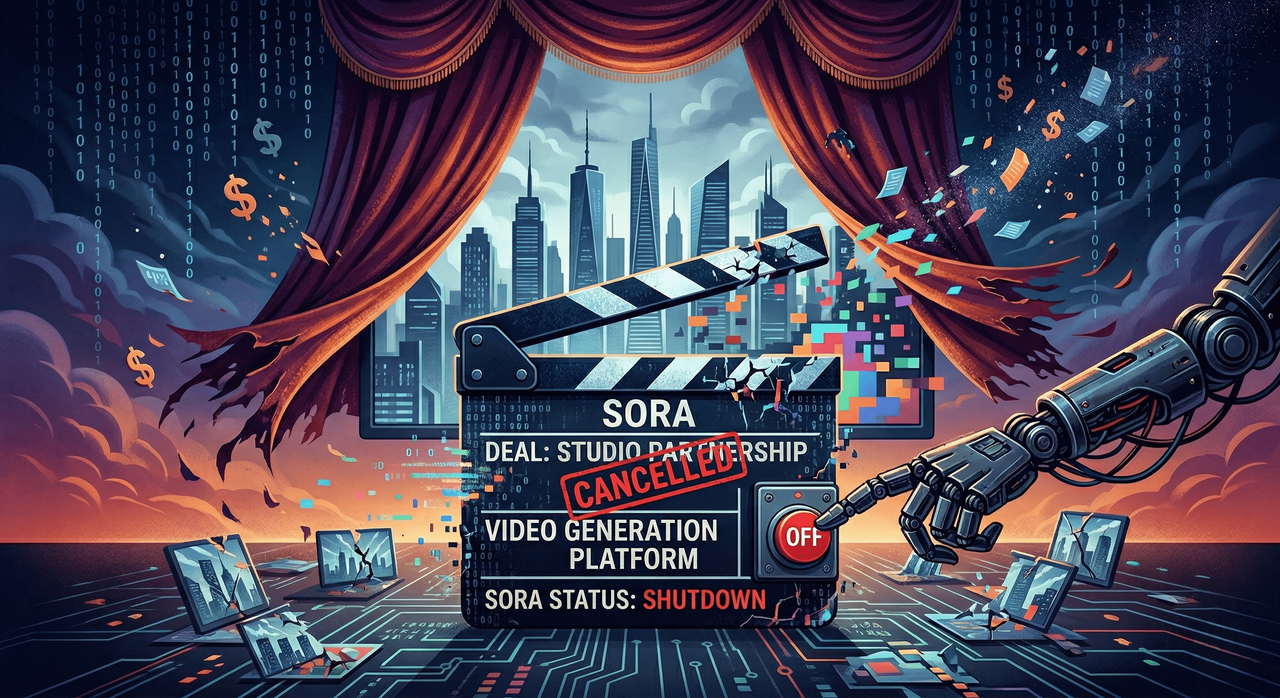
OpenAI Shutters Sora and Ends $1 Billion Disney Deal — The End of the AI Video Hype?
It’s the end of an era—and a surprisingly short one at that. In a move that has sent shockwaves through Silicon Valley and Hollywood alike, OpenAI has officially pulled the plug on Sora, its groundbreaking (and highly controversial) text-to-video platform.
If you feel like you just got used to seeing those hyper-realistic AI videos on your feed, you aren’t alone. Here is the breakdown of what happened, why it matters, and what this says about the chaotic state of AI right now.
The Billion-Dollar Breakup
The most jarring part of this announcement isn't just the tech shutting down; it’s the high-profile wreckage left in its wake. Just months ago, OpenAI was celebrating a massive $1 billion equity deal with Disney. The goal was revolutionary: allowing the world’s most iconic characters to be brought to life within the Sora ecosystem.
Now, that partnership is essentially over. While Disney issued a polite statement "respecting the decision," the silence regarding what happens to that billion-dollar investment speaks volumes. One day you’re dreaming of AI-generated Star Wars shorts; the next, the doors are locked.
Why Pull the Plug Now?
OpenAI’s official stance is that they are shifting focus toward "real-world physical tasks." In plain English? They are likely pivoting harder toward robotics and AGI (Artificial General Intelligence) that can interact with the physical world, rather than just generating pretty pixels.
However, if you read between the lines, there are three major factors likely at play:
- The Compute Crunch: Generating high-def video is an absolute resource hog. As demand for compute power grows, OpenAI has to decide if it wants to spend its chips on "cool videos" or "smarter brains."
- The Legal Minefield: Between copyright infringement lawsuits and the terrifying rise of deepfake pornography, video generation has become a massive liability. Unlike text, a deepfake video is a PR nightmare that’s much harder to "guardrail."
- The Push for Profit: With Sam Altman reportedly eyeing an IPO (Initial Public Offering), OpenAI needs to prove it can be profitable. Sora, for all its "wow" factor, might have been too expensive to run at scale without a clear path to the bottom line.
The Last Ones Standing
Interestingly, this move highlights a growing divide in the industry. While Google (with Veo) and Elon Musk’s Grok (with Imagine) are still charging ahead into the video space, others are staying far away.
Anthropic, the creators of Claude, famously decided from day one not to touch image or video generation to avoid these exact legal and ethical headaches. It seems OpenAI is finally starting to see the wisdom in that "safety-first" approach.
Final Thoughts: A Reality Check for the Hype Train
As someone watching this space daily, this feels like a "maturation" moment for AI. For the past two years, we’ve been in the "Look what I can do!" phase. Now, we’re entering the "How do we actually make this work without breaking the law or the bank?" phase.
Sora was breathtaking, but it was also a ghost in the machine—beautiful, but maybe a little too haunted by legal and ethical ghosts for comfort.
What do you think? Was Sora a revolution cut short, or a mistake that OpenAI is lucky to walk away from? Let me know in the comments!

Comments
No comments yet. Be the first to share your thoughts!
Leave a Comment