

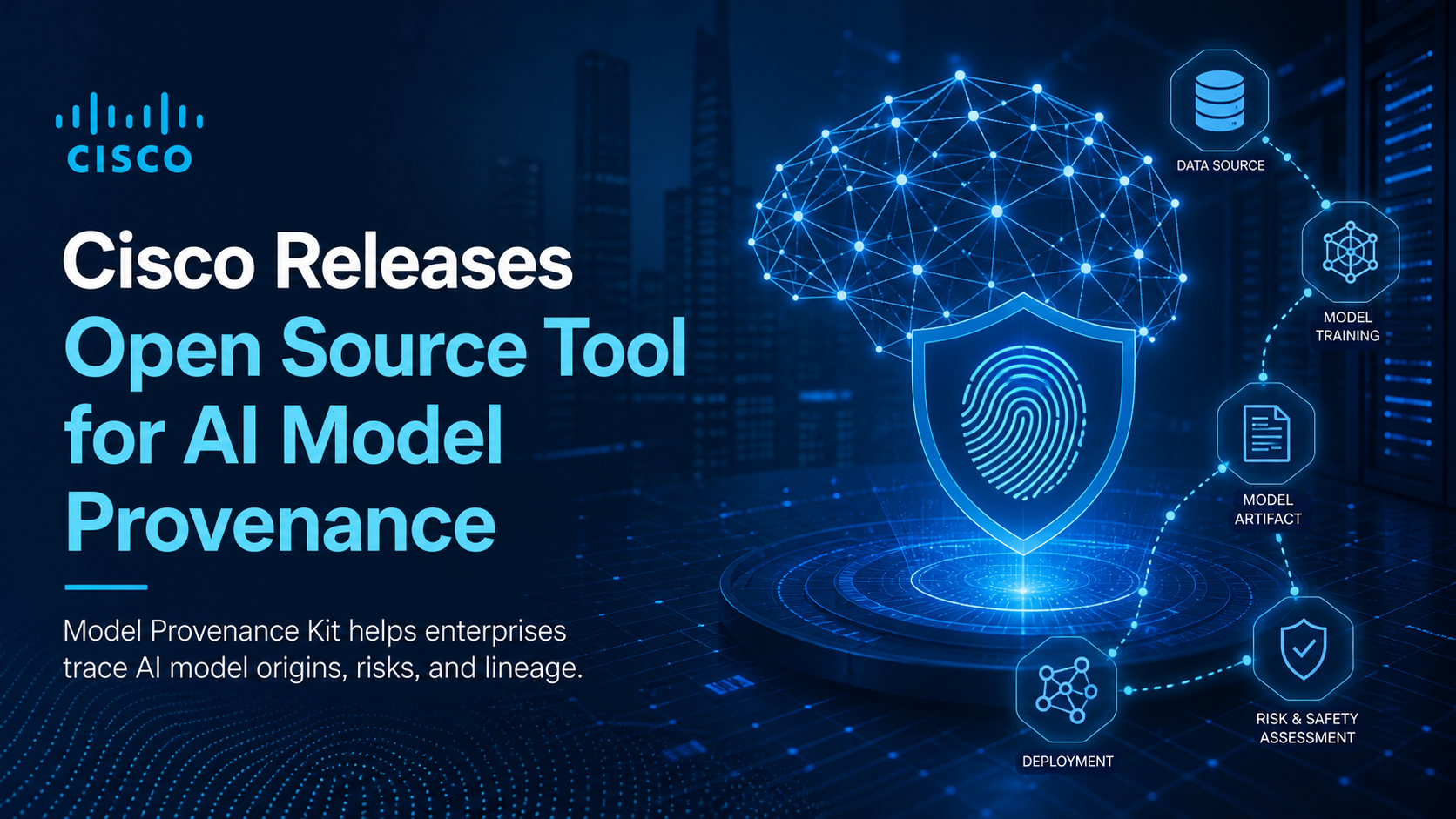
Cisco Releases Open Source Model Provenance Kit to Strengthen AI Model Security and Transparency
Cisco has introduced a new open source tool called the Model Provenance Kit, a Python-based toolkit and command-line interface designed to help organizations better understand where their artificial intelligence models come from, how they may have changed over time, and whether they carry hidden security, compliance, or operational risks.
The release highlights a growing challenge in enterprise AI adoption: many organizations are rapidly integrating third-party AI models into internal systems, customer-facing applications, chatbots, autonomous agents, and generative AI workflows without having full visibility into the origin, lineage, or integrity of those models.
As businesses increasingly rely on model repositories such as Hugging Face, where millions of AI models are available for download and adaptation, the need for stronger AI model provenance has become more urgent. Cisco’s Model Provenance Kit aims to address this need by giving developers, security teams, compliance officers, and AI governance leaders a practical way to examine and compare models using evidence-based fingerprinting techniques.
Why AI Model Provenance Matters
AI model provenance refers to the ability to trace the origin, development history, modifications, and relationships of an AI model. In simpler terms, it helps answer a critical question: Where did this model come from, and what has happened to it since it was created?
This question is becoming increasingly important as organizations adopt third-party models that may have been fine-tuned, merged, distilled, repackaged, or modified by multiple contributors. While open model ecosystems have accelerated innovation, they have also introduced risks that many enterprises are not fully prepared to manage.
A model may appear trustworthy because it is published in a popular repository or accompanied by a model card, but the claims made by developers are not always independently verified. Details about training data, known vulnerabilities, license restrictions, safety limitations, and bias risks can be incomplete, outdated, or inconsistent.
For downstream users, this creates a major governance problem. An enterprise may unknowingly deploy a model that has inherited weaknesses from another model, contains poisoned data, includes hidden vulnerabilities, or has training biases that make it unsuitable for a specific business use case.
Cisco’s new tool is intended to help organizations reduce this uncertainty by providing a structured way to compare AI models and identify shared lineage.
The Security Risks of Unverified AI Models
The security implications of poor AI model provenance can be significant. If an organization deploys a third-party model without knowing its origin, it may inherit vulnerabilities that are difficult to detect through standard testing.
For example, a model used in an internal chatbot could be vulnerable to manipulation. A customer-facing AI assistant could generate biased or unsafe outputs because of weaknesses in its training data. An agentic AI application could inherit flaws from a base model that was later fine-tuned or repackaged by another developer.
The problem becomes even more serious when organizations use multiple models across different teams and applications. Without provenance tracking, a single vulnerable base model may quietly spread throughout the enterprise AI stack. If an incident occurs, security teams may struggle to identify which applications are affected, which models share the same lineage, and where remediation should begin.
Cisco emphasized that without provenance, organizations have no easy way to trace an AI-related incident back to its root cause. This lack of visibility can delay incident response, complicate remediation, and increase the likelihood that the same vulnerability will continue to affect other systems.
Compliance, Licensing, and Liability Concerns
Beyond cybersecurity, AI model provenance also plays an important role in regulatory compliance and legal risk management.
Governments and regulatory bodies are increasingly focused on how organizations document, govern, and deploy AI systems. Enterprises may be required to demonstrate that they understand the models they use, the data those models were trained on, and the risks associated with their deployment.
Licensing is another major concern. A model may be derived from another model with licensing terms that restrict commercial use, redistribution, or modification. If an organization cannot trace a model’s lineage, it may unknowingly violate licensing conditions.
This creates potential liability for companies that rely on third-party AI models in production environments. Without a reliable method for checking model origins and relationships, legal and compliance teams may have limited ability to evaluate whether a model is safe, permitted, and appropriate for enterprise use.
Cisco’s Model Provenance Kit helps address these concerns by supporting a more transparent and evidence-based approach to AI supply chain integrity.
How Cisco’s Model Provenance Kit Works
The Model Provenance Kit generates a unique “fingerprint” for AI models by analyzing multiple technical signals. These signals include metadata, tokenizer similarity, and weight-level identity indicators such as embedding geometry, normalization layers, energy profiles, and direct weight comparisons.
This fingerprinting approach allows the tool to evaluate whether two models may share a common lineage, even when a model has been modified, fine-tuned, or repackaged.
The toolkit includes two primary operating modes: compare and scan.
The compare mode allows users to analyze two models and determine whether they share lineage. This can be useful when an organization wants to verify whether a model is derived from a known base model or whether two models are related in meaningful ways.
The scan mode attempts to identify the closest lineage for a given model by comparing its fingerprint against a database of model fingerprints compiled by Cisco. This can help organizations investigate unknown models and better understand their possible origins.
Because the tool is Python-based and includes a command-line interface, it is likely to be especially useful for AI engineers, machine learning teams, security researchers, and enterprise governance teams that want to integrate provenance checks into their existing workflows.
A Step Toward AI Supply Chain Security
Cisco’s release reflects a broader shift in enterprise AI security. As AI models become core components of business software, they are increasingly being treated as part of the software supply chain.
Traditional software supply chain security focuses on source code, dependencies, packages, containers, and build systems. AI introduces a new layer of complexity because models are not static assets. They can be fine-tuned, merged, distilled, adapted, or redistributed in ways that obscure their origins.
This makes AI model provenance more difficult than simply checking a file name, repository page, or model card. A model may carry technical similarities to another model even if its public metadata does not clearly reveal that relationship.
Cisco’s Model Provenance Kit attempts to solve this problem by using a more technical and evidence-driven method. Instead of relying only on developer-provided claims, the tool examines model characteristics directly.
This approach could help enterprises build stronger AI governance programs by making model verification more systematic and repeatable.
Benefits for Enterprises Using Third-Party AI Models
For organizations adopting third-party AI models, the Model Provenance Kit offers several practical benefits.
First, it can improve visibility into the AI model supply chain. Security teams can better understand whether a model is related to another known model, whether it may have inherited risks, and whether it should be reviewed more carefully before deployment.
Second, it can support incident response. If a vulnerability or bias issue is discovered in one model, organizations can use provenance analysis to identify other models that may share the same root lineage.
Third, it can help with compliance and documentation. Enterprises can use model fingerprints and lineage checks as part of their AI governance records, supporting internal audits and regulatory reporting.
Fourth, it can reduce blind trust in public model repositories. While repositories are valuable for innovation, organizations still need independent methods for validating model claims. Cisco’s toolkit gives users a way to conduct deeper technical checks.
Open Source Availability
Cisco has made the Model Provenance Kit available as an open source project on GitHub. The company’s dataset of base model fingerprints is also available on Hugging Face.
This open source approach is important because AI provenance is not a challenge that one company can solve alone. The AI ecosystem depends on collaboration among researchers, developers, enterprises, security teams, and open source communities.
By releasing the toolkit publicly, Cisco is encouraging broader experimentation, validation, and improvement. Organizations can test the tool, contribute to its development, and potentially integrate it into their own AI security and governance workflows.
The Future of AI Model Provenance
As AI adoption continues to expand, model provenance will likely become a standard requirement for responsible AI deployment. Enterprises will need to know not only whether a model performs well, but also whether it is secure, compliant, properly licensed, and appropriate for the intended use case.
The growing use of generative AI and agentic AI makes this even more important. Models are increasingly being connected to business systems, customer data, APIs, and automated decision-making workflows. In this environment, hidden vulnerabilities or unknown lineage can create serious operational risks.
Cisco’s Model Provenance Kit represents a meaningful step toward stronger AI transparency. It does not eliminate all risks associated with third-party AI models, but it gives organizations a practical way to begin answering one of the most important questions in modern AI governance: Can we trust the origin of the model we are using?
For enterprises building long-term AI strategies, tools like the Model Provenance Kit may become essential components of responsible AI security, compliance, and supply chain management.


Comments
No comments yet. Be the first to share your thoughts!
Leave a Comment