

Unprecedented Paradigm Shift: How Anthropic's Claude Mythos AI Helped Crack Apple’s M5 Security Architecture
The cybersecurity landscape has just witnessed a seismic shift. For over a decade, Apple devices have held a gold-standard reputation in the consumer tech space, largely regarded as some of the hardest systems to compromise. This reputation was built on Apple’s walled-garden approach and its tightly integrated hardware and software security architectures. However, the relentless advancement of artificial intelligence is beginning to challenge even the most fortified digital ecosystems.
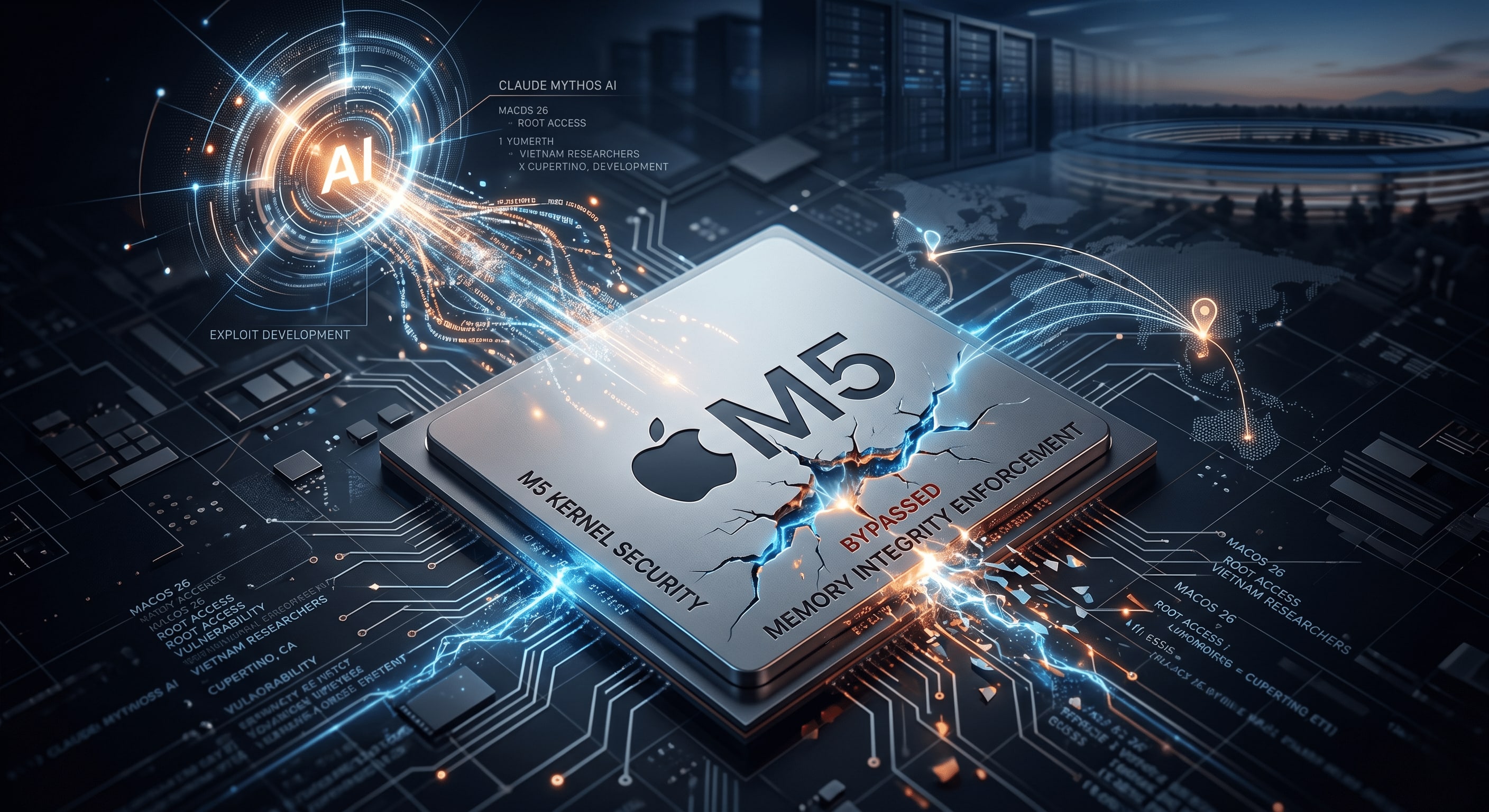
In a groundbreaking revelation, Calif—a pioneering security startup based in Vietnam—has announced that a small team of its researchers successfully utilized a preview version of Anthropic’s highly classified Claude Mythos AI to engineer a working exploit against Apple’s state-of-the-art M5 chip protections. Astoundingly, this feat was accomplished in less than a single week.
As an analyst monitoring global cybersecurity trends, I recognize this not just as a vulnerability report, but as a historic milestone that bridges human ingenuity with next-generation AI capabilities. Here is a comprehensive report on how this unfolded, the mechanics of the exploit, and what it means for the future of digital security worldwide.
The Fortress: Apple M5 and Memory Integrity Enforcement (MIE)
To understand the magnitude of this exploit, we must first look at the target. The exploit chain specifically targets macOS 26 running on Apple’s latest bare-metal M5 hardware.
Historically, memory corruption bugs have remained one of the most prevalent and devastating vectors for attackers seeking to breach operating systems and applications. These vulnerabilities allow threat actors to crash programs, exfiltrate highly sensitive data, or even achieve total system takeover. In response to this persistent threat, Apple engineered the M5 chip with a revolutionary feature known as Memory Integrity Enforcement (MIE).
MIE relies on sophisticated memory-tagging technology designed to make memory corruption attacks exponentially more difficult, if not practically impossible for standard automated tools. The industry widely viewed MIE as an ironclad defense mechanism. Yet, the rapid integration of advanced Large Language Models (LLMs) into security research has dramatically altered the offensive playbook.
The Calif Breakthrough: Timeline and Mechanics
According to a detailed Substack post published this Thursday by Calif, the timeline of this discovery was remarkably compressed. The researchers stumbled upon the initial bugs entirely by accident on April 25. By May 1—mere days later—they had successfully developed a fully functional exploit.
Calif claims this is the first publicly acknowledged macOS kernel memory corruption exploit capable of surviving the rigid MIE protections on M5 hardware. The attack path itself is a masterclass in modern exploitation:
- Initial Access: The attack initiates from a standard, unprivileged local user account.
- Escalation: Utilizing standard system calls, the exploit chain combines two distinct vulnerabilities.
- Hardware Targeting: The attack applies additional, highly specialized techniques targeting the bare-metal M5 hardware with kernel MIE fully enabled, ultimately escalating privileges to grant root access.
Demonstrating a blend of old-school hacker ethos and modern corporate strategy, Calif chose a unique GEO-strategic approach to disclosure. Rather than submitting the bug through remote digital portals, the Vietnam-based team traveled directly to Apple’s sprawling headquarters in Cupertino, California.
As Calif candidly explained in their report: “We wanted to report it in person, instead of getting buried in the submission flood that some unfortunate Pwn2Own participants just experienced. Most respected hackers avoid human interaction whenever possible, so this physical strategy may give us a slight edge in the eternal race for five minutes of fame and glory on Twitter.”
Enter Claude Mythos: The Ultimate Cyber-Assistant
The true catalyst in this narrative is Anthropic’s Claude Mythos AI. In April, Anthropic released a preview version of Mythos exclusively to a heavily restricted cohort of technology companies, major banks, and select researchers under an initiative dubbed Project Glasswing.
This restricted rollout was not an arbitrary business decision. Extensive internal testing and rigorous outside evaluations revealed that Mythos possessed an unprecedented capability to autonomously identify, analyze, and exploit software vulnerabilities at a level far surpassing any previously public AI model.
Calif explicitly noted that Mythos Preview was instrumental in identifying the root vulnerabilities and assisting the team throughout the complex exploit development cycle. However, they were careful to emphasize that the AI did not act alone. Human expertise, intuition, and deep architectural knowledge were absolutely critical to definitively bypass Apple’s new MIE protections.
“Part of our motivation was to test what’s possible when the best models are paired with experts,” the startup wrote. “Landing a kernel memory corruption exploit against the best protections in a week is noteworthy, and says something strong about this pairing.”
The Global Implications of AI-Driven Cyber Warfare
The Calif exploit is not an isolated incident; it is part of a broader, rapidly accelerating trend. The capabilities of Claude Mythos are already making waves across international tech and intelligence communities:
- Mozilla Firefox Integration: Internal testing by Mozilla revealed that Mythos successfully identified an astounding 271 distinct vulnerabilities within the Firefox browser.
- Government and Intelligence Utilization: The U.K.’s AI Security Institute reported that the model could autonomously execute and complete sophisticated, multi-stage cyberattack simulations. Concurrently, it has been revealed that the U.S. National Security Agency (NSA) is actively utilizing Mythos, notably amidst an ongoing geopolitical feud between Anthropic and the Donald Trump administration.
Despite these jaw-dropping capabilities, public access to the model remains highly unlikely in the near term. On Myriad—a popular prediction market platform operated by Dastan (parent company of Decrypt)—users currently price the odds of a full public launch of Claude Mythos by June 30 at a mere 10.5%. The dual-use nature of this technology makes it simply too potent for unrestricted public release.
Final Thoughts: Preparing for the "Bugmageddon"
The intersection of generative AI and offensive cybersecurity is no longer a theoretical concept discussed at industry conferences; it is an active reality successfully cracking the world's most secure consumer hardware.
Calif aptly summarized the gravity of their findings, calling the Apple M5 exploit “a glimpse of what is coming.”
“Apple built MIE in a world before Mythos Preview,” Calif noted. “We’re about to learn how the best mitigation technology on Earth holds up during the first AI bugmageddon.”
As security professionals, developers, and tech enthusiasts, we must recognize that the paradigm has shifted. Defense strategies must evolve at the speed of AI. If an unprivileged user can achieve root access on an MIE-protected M5 chip in under a week with AI assistance, the security industry must urgently rethink its threat models. The age of human-AI synergistic hacking has officially arrived.


Comments
No comments yet. Be the first to share your thoughts!
Leave a Comment