

Google’s $9.99 AI Health Coach Launches May 19: A New Era for Fitbit, Pixel Watch, and Personalized Wellness
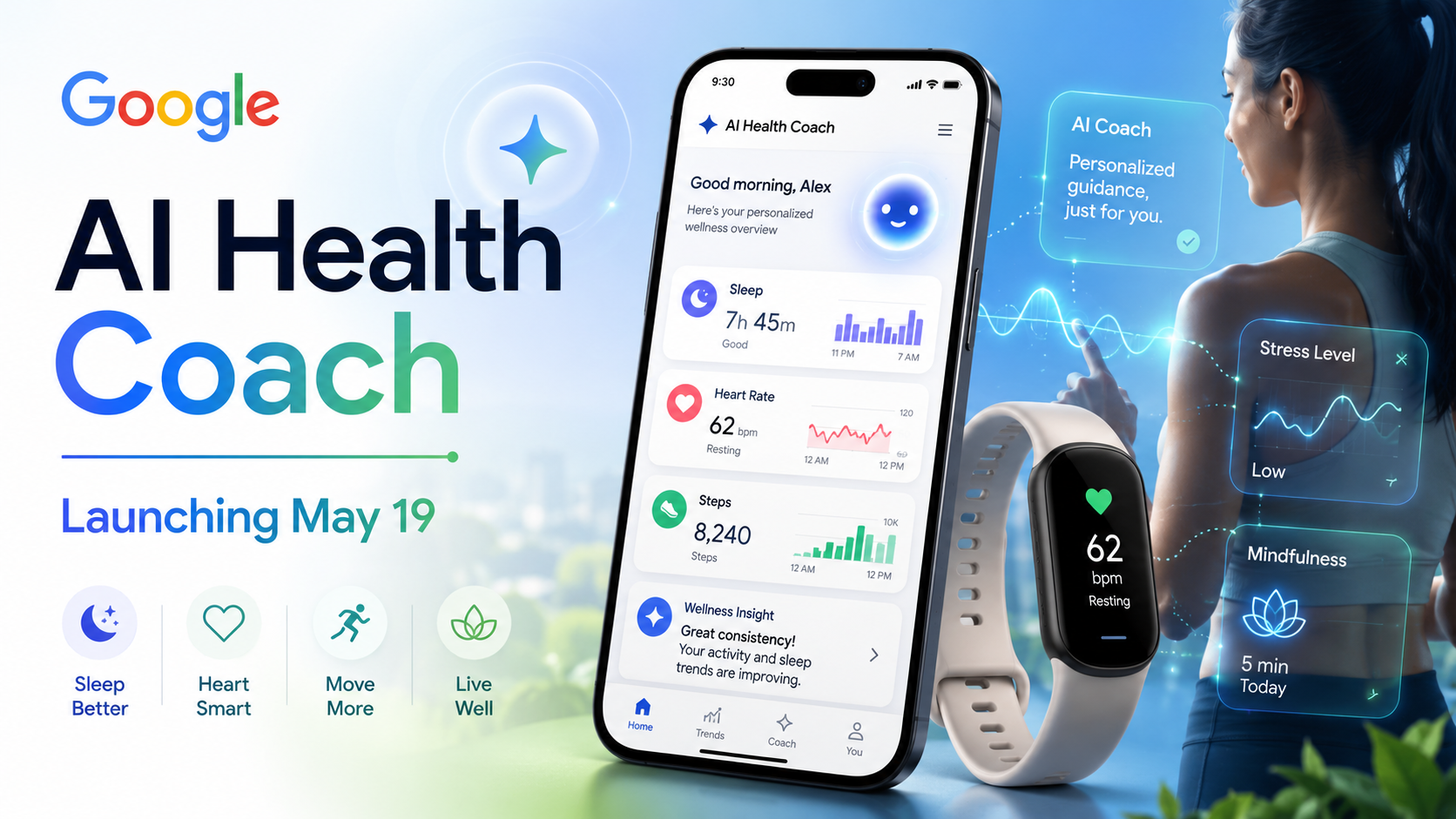
Google is preparing to make one of its biggest moves yet in the digital health and wearable technology market. On May 19, the company will officially launch its new AI-powered health coach as part of a broader rebranding of the Fitbit app into Google Health. The service will be offered through Google Health Premium, a subscription plan priced at $9.99 per month or $99 per year.
The launch arrives alongside the debut of the Fitbit Air, a new fitness band that appears designed to compete more directly with performance-focused wearables such as Whoop. Together, the new device and the redesigned health app signal a major shift in Google’s fitness strategy. Instead of treating Fitbit as a standalone wearable brand, Google is now building a more integrated health ecosystem powered by Gemini AI, Pixel Watch, Fitbit devices, and personalized wellness data.
For users, this means Google Health is no longer just a place to view step counts, sleep scores, and heart rate charts. It is becoming a central hub for health insights, fitness coaching, sleep guidance, nutrition tracking, and wellness recommendations.
Google Health Replaces Fitbit Premium With a Broader AI Strategy
Google acquired Fitbit in 2021, giving the company a stronger position in the wearables market. While Google already had Android smartwatches and later expanded its own Pixel Watch lineup, Fitbit brought years of experience in fitness tracking, sleep monitoring, health metrics, and subscription-based wellness tools.
Now, Google appears ready to merge those strengths under one larger brand: Google Health.
The former Fitbit app is being rebranded as Google Health, while Fitbit Premium is being replaced by Google Health Premium. The new subscription will still cost $9.99 per month or $99 per year, but its focus is expanding beyond traditional fitness tracking. The main attraction is the new Google Health Coach, an AI-powered assistant designed to provide personalized recommendations based on a user’s goals, habits, health data, and daily routine.
Google says the health coach has been in public preview since last year. During that preview period, the company gathered user feedback and improved the service before preparing it for a wider launch.
What Is Google’s AI Health Coach?
The Google Health Coach is an AI-powered wellness assistant built with Google’s Gemini technology. It is designed to act as a combination of a fitness coach, sleep expert, and health advisor. Rather than simply showing users raw health data, the coach aims to interpret that information and turn it into practical guidance.
For example, instead of only telling a user that they slept poorly, the coach may connect sleep quality with recent workouts, stress patterns, nutrition habits, or environmental factors. Instead of only showing heart rate trends, it may suggest changes to recovery, exercise intensity, or daily routines.
The coach will be available through the Today tab in the Google Health app. Google says the insights will not be simple summaries. Instead, the AI coach will combine information from multiple sources, including fitness metrics, sleep data, nutrition, cycle tracking, mental well-being features, environmental signals, and U.S. medical records if the user chooses to provide access.
This is important because health data is often fragmented. A person may track workouts in one place, sleep in another, meals in another, and medical records somewhere else. Google’s goal is to bring more of that information together and use AI to generate more useful, personalized insights.
Personalized Onboarding: How the Coach Learns About You
One of the most important parts of the new service is the onboarding process. Google says users will be able to tell the health coach about their personal goals, daily routine, exercise equipment, injuries, lifestyle habits, and other relevant details.
This means the AI coach should not give the same advice to everyone. A user training for a marathon may receive very different suggestions from someone trying to improve sleep, lose weight, build strength, reduce stress, or simply move more during the day.
Users will also be able to update their details at any time using natural language. That means they can speak or type to the coach in a conversational way. For example, someone could tell the coach they have started a new job, changed their workout schedule, suffered a minor injury, bought new gym equipment, or decided to focus on better nutrition.
The coach can also help users log workouts, meals, health records, and other information by dictation. Google says users may also upload photos or files, which could make tracking more flexible and less dependent on manual entry.
AI Features Across Fitness, Sleep, and Health Tabs
Google is not limiting the AI coach to a single chat-style experience. The company says the AI will appear throughout the Google Health app.
In the Fitness tab, users can expect workout suggestions and guidance based on their activity history, goals, and available equipment. This could help people avoid generic exercise plans and receive recommendations that better match their real lives.
In the Sleep tab, the AI coach will provide sleep tracking insights and suggestions. This may be especially useful for users who want to understand patterns behind poor sleep, irregular schedules, recovery problems, or lifestyle factors affecting rest.
In the Health tab, the app will summarize key metrics and offer broader wellness insights. Google has also redesigned cycle tracking, nutrition, and mental well-being features so they can work more closely with the new health coach.
The result is an app that tries to move beyond passive tracking. Instead of only collecting data, Google Health is being positioned as a personalized assistant that helps users understand what their data means and what actions they might take next.
Who Can Use Google’s AI Health Coach First?
At launch, the AI health coach will first be available for select Fitbit and Pixel Watch users. Google says support for additional devices is coming soon, although it has not provided a clear timeline for when people without Fitbit or Pixel Watch devices will gain access to the full coaching experience.
Anyone will be able to download the Google Health app and get started. However, users without a supported Fitbit or Pixel Watch will be notified when the AI coach is ready for them.
This staged rollout makes sense from a technical and product standpoint. Fitbit and Pixel Watch devices already collect detailed health and fitness data, giving the AI coach more information to work with. Users without compatible wearables may not receive the same level of personalized coaching until Google expands support or integrates more third-party data sources.
Google AI Pro and Ultra Subscribers Get Extra Value
Another important detail is that Google AI Pro and Google AI Ultra subscribers will receive access to Google Health Premium at no additional cost. This shows how Google is trying to connect its AI subscription ecosystem across different products.
Instead of selling AI only as a chatbot or productivity tool, Google is placing Gemini into more everyday services, including health, fitness, sleep, and wellness. For users already paying for Google’s premium AI plans, the inclusion of Google Health Premium could make those subscriptions more attractive.
For Google, this also creates a stronger reason for users to stay inside the company’s ecosystem. A person using Gemini, Pixel Watch, Fitbit, Android, and Google Health may find it easier to continue using Google services rather than switching to competitors.
Why This Launch Matters for the Wearables Market
The launch of Google’s AI health coach could increase competition in the wearable health space. Apple, Whoop, Garmin, Oura, Samsung, and other companies are all trying to make health data more useful and actionable.
The challenge for most wearable users is not the lack of data. Modern devices already track steps, heart rate, sleep, activity, oxygen levels, recovery, calories, and other metrics. The real problem is interpretation. Many users do not know what to do with the data once they see it.
Google’s AI coach is designed to solve that problem by turning health metrics into guidance. If the service works well, it could make Fitbit and Pixel Watch devices more valuable, especially for people who want coaching but do not want to hire a personal trainer, sleep consultant, or nutrition coach.
At the same time, Google will need to be careful. Health recommendations are sensitive, and users may rely on AI-generated advice when making decisions about exercise, sleep, diet, or wellness. Google will likely need to make clear that the coach is not a replacement for professional medical care.
Privacy and Health Data Will Be a Major Question
Because the service uses personal health information, privacy will be one of the biggest concerns. The AI coach may combine fitness, sleep, nutrition, cycle tracking, mental wellness data, environmental signals, and even medical records if access is granted.
That level of personalization can make the service more useful, but it also means users will want clear answers about how their data is stored, processed, protected, and used. Health data is deeply personal. Google’s success in this area will depend not only on how smart the coach is, but also on whether users trust the company with sensitive wellness information.
Users should review privacy settings carefully before connecting medical records or uploading personal health files. They should also remember that AI-generated wellness guidance should support, not replace, advice from qualified medical professionals.
Final Thoughts
Google’s $9.99-per-month AI health coach marks a major step in the evolution of Fitbit and Google’s broader health strategy. By rebranding the Fitbit app as Google Health and introducing an AI-powered coaching experience, Google is moving from simple tracking toward personalized, AI-guided wellness.
The service launches globally on May 19 as part of Google Health Premium, with early access for select Fitbit and Pixel Watch users. It will use Gemini AI to provide customized insights across fitness, sleep, nutrition, mental well-being, cycle tracking, and health metrics.
For consumers, the appeal is clear: a more personal health app that can understand goals, routines, injuries, workouts, sleep patterns, and lifestyle factors. For Google, the launch strengthens its position in wearables, subscriptions, and AI-powered consumer services.
If Google can balance useful coaching with strong privacy protections and responsible health guidance, Google Health Coach could become one of the most important AI wellness tools in the market.



Comments
No comments yet. Be the first to share your thoughts!
Leave a Comment