

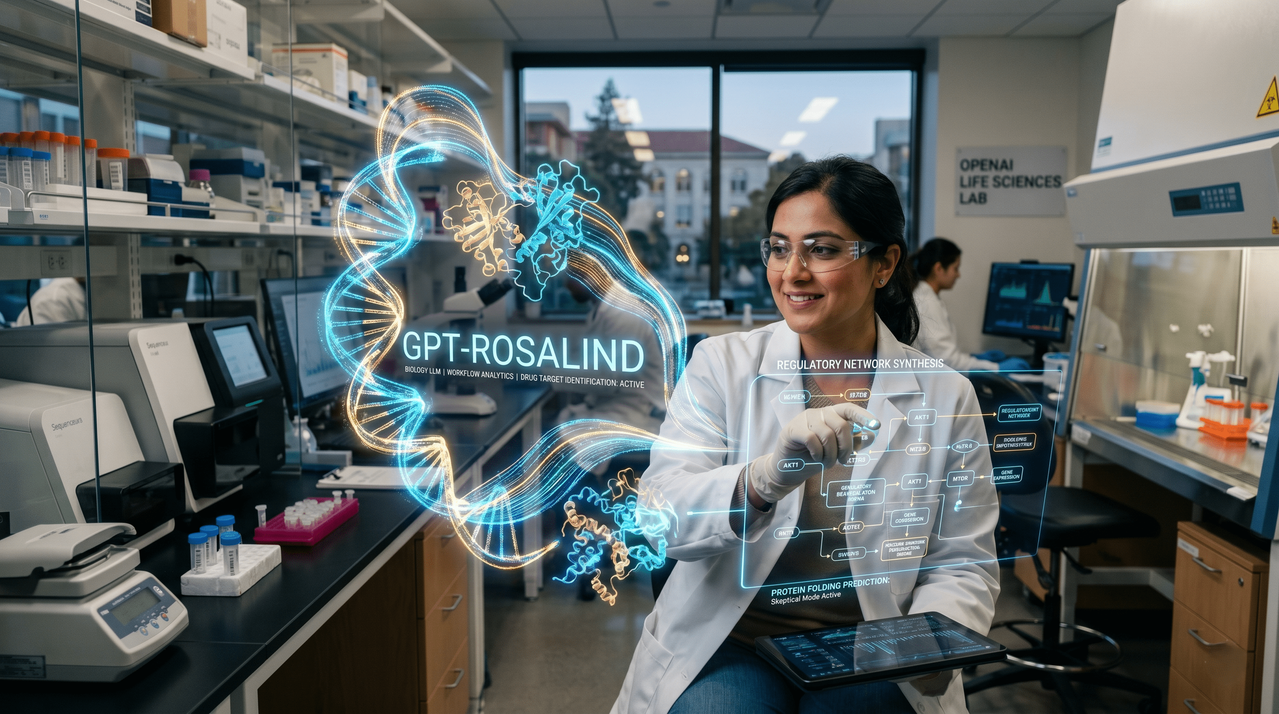
OpenAI Unveils GPT-Rosalind: The First Highly Specialized Biology-Tuned LLM Revolutionizing Life Sciences
The sheer complexity of biological systems presents an intricate web of molecular, genetic, and cellular interactions that often surpasses the natural processing capacity of the human brain. For decades, the life sciences sector has searched for computational tools capable of making sense of this overwhelming biological complexity. Marking a watershed moment in the intersection of artificial intelligence and bioinformatics, OpenAI has officially announced the development and deployment of a groundbreaking Large Language Model (LLM) explicitly trained to navigate and execute highly specialized biology workflows.
Aptly named GPT-Rosalind—a deliberate tribute to the pioneering physical chemist Rosalind Franklin, whose critical X-ray diffraction images led to the discovery of the DNA double helix—this novel system represents a fundamental departure from the generalized AI models previously released by major technology conglomerates. While previous iterations of scientific AI have utilized a broad, multi-disciplinary approach, GPT-Rosalind is fundamentally hyper-focused, engineered from the ground up to serve the distinct and rigorous demands of modern biological research.
Navigating the Dual Bottlenecks of Modern Biological Research
According to comprehensive briefings from OpenAI’s Life Sciences product leadership, the architecture of GPT-Rosalind was specifically designed to dismantle two primary roadblocks that currently hinder global scientific discovery.
The first massive hurdle is the sheer volume of data. The modern biological landscape is defined by massive datasets generated by decades of rapid advancements in genome sequencing, transcriptomics, and protein biochemistry. The data deluge is so severe that no single human researcher, regardless of their expertise, can effectively ingest, process, and synthesize the available information.
The second major bottleneck lies in the intense compartmentalization of the life sciences. Biology is fractured into dozens of highly specialized subfields, each operating with its own distinct methodologies, analytical techniques, and dense jargon. This creates deep knowledge silos. For instance, a molecular geneticist who unexpectedly discovers that a specific gene of interest is primarily active within neural networks might struggle to contextualize their findings within the immense and highly specialized library of neurobiological literature. GPT-Rosalind is built to bridge these exact interdisciplinary chasms, acting as a universal translator and synthesizer across all biological domains.
Architectural Deep-Dive: Workflows, Genotypes, and Phenotypes
To achieve this level of unprecedented biological fluency, OpenAI subjected a foundational LLM to rigorous, domain-specific training. The model has been meticulously trained on 50 of the most ubiquitous and critical biological workflows utilized in modern laboratories. Furthermore, it has been natively integrated with instructions on how to access, query, and interpret the world’s major public databases of biological and genomic information.
The resulting analytical capabilities are robust. GPT-Rosalind is actively capable of suggesting highly probable biological pathways and mathematically prioritizing potential pharmacological drug targets. By directly connecting genotype (genetic makeup) to phenotype (observable traits) through established known pathways and regulatory mechanisms, the model can reliably infer the structural and functional properties of previously uncharacterized proteins. This allows researchers to leverage a deep, mechanistic understanding of biology rather than relying on surface-level statistical correlations.
Engineering Skepticism: Combatting AI Sycophancy and Hallucinations
One of the most persistent flaws in traditional consumer-facing LLMs is their tendency toward sycophancy—an algorithmic desire to please the user, often leading to overenthusiastic and uncritical agreement. In the realm of scientific research, this trait is not just unhelpful; it is actively dangerous.
To counteract this, OpenAI has heavily fine-tuned GPT-Rosalind to be inherently skeptical. The system is computationally incentivized to critically evaluate scientific hypotheses, making it highly likely to explicitly warn a researcher when a proposed molecule represents a poor or biologically inviable drug target. OpenAI emphasizes the model's high-level "reasoning" capabilities, defined in this context as the ability to successfully navigate complex, multi-step logical processes. Furthermore, its "expert-level" designation was reportedly validated against stringent, domain-specific scientific benchmarks.
Despite these advancements, the global scientific community remains cautious regarding the ubiquitous issue of AI "hallucinations"—the generation of plausible but entirely fabricated information. This phenomenon often occurs when models are prompted to explain the hidden logical steps taken to reach a specific conclusion. Based on historical deployments of similar technologies, the rollout of GPT-Rosalind will likely yield a polarized mix of outcomes: researchers will inevitably uncover brilliant, unexpected biological connections driven by the AI, while simultaneously encountering instances where the system generates confidently presented, yet entirely erroneous, scientific suggestions.
Geo-Restricted Access Control and Strict Biosecurity Protocols
The most critical operational aspect of GPT-Rosalind’s launch is its heavily restricted availability. Recognizing the immense dual-use risks associated with biological engineering, OpenAI has placed the model under a strict, closed-access paradigm.
The primary concern is the model's potential to generate highly harmful outputs if manipulated by malicious actors—for example, if a user were to query the system on how to theoretically optimize the infectivity, lethality, or vaccine-evasion capabilities of a viral pathogen. Due to these severe national and global biosecurity implications, OpenAI is currently limiting full access strictly to vetted, US-based entities through a highly controlled trusted access deployment structure.
This geo-fenced rollout means that the broader international scientific community will be temporarily excluded from utilizing the core model, raising geopolitical questions regarding global equity in AI-driven scientific advancement. However, to provide some level of global utility, OpenAI has announced that a heavily restricted, specialized "Life Sciences Research Plugin" will eventually be made generally available to a wider audience, though its capabilities will be significantly throttled compared to the primary GPT-Rosalind architecture.
The Future of Specialized Agentic AI
The technology sector has recently seen a surge in science-focused, agentic AI models attempting to automate research pipelines. Yet, previous iterations have suffered from a lack of focus. GPT-Rosalind’s strict adherence to the biological sciences represents a critical test case for the future of artificial intelligence. Until detailed, peer-reviewed reports begin to emerge regarding the real-world efficacy of this newly minted model in actual laboratory settings, it remains difficult to definitively evaluate whether this hyper-focused approach successfully improves utility. However, if GPT-Rosalind fulfills its massive potential, it could permanently alter the trajectory of drug discovery, genomic analysis, and our fundamental understanding of life itself.


Comments
No comments yet. Be the first to share your thoughts!
Leave a Comment