

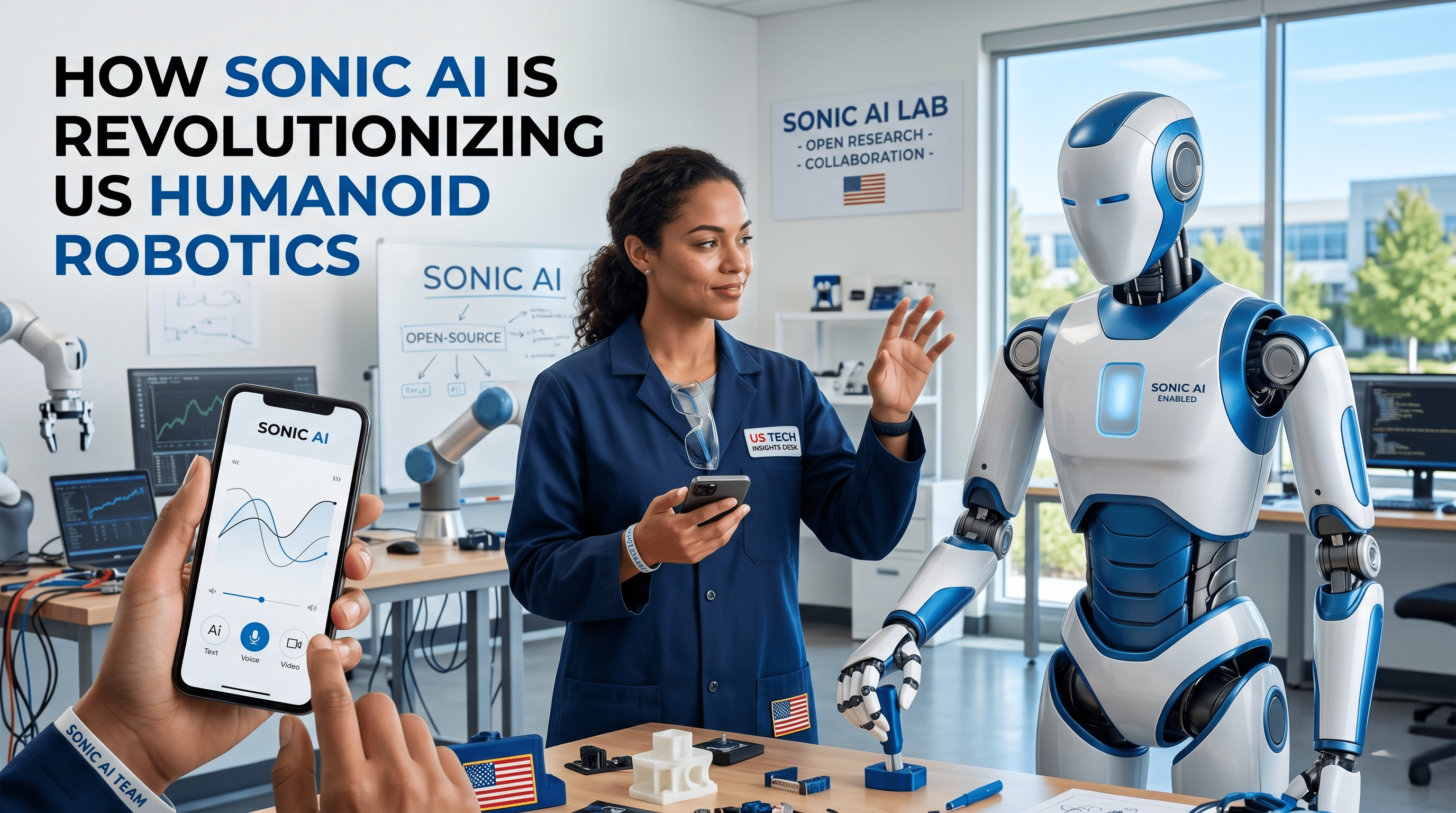
The Next Leap in Humanoid Robotics: How the "Sonic" AI Controller is Rewriting the Rules of Automation
By Tech Insights Desk | Advanced AI & Robotics
For decades, the American public has been captivated by the promise of humanoid robots. From the pages of science fiction to the bustling laboratories of Silicon Valley, the dream has always been the same: machines capable of seamlessly integrating into our daily lives, performing mundane chores, and undertaking perilous missions. Yet, historically, the reality has been fraught with technological stumbling blocks. Early iterations of robotic companions required thousands of simulated trials just to take a single step without spectacularly falling over.
Today, that narrative is shifting dramatically. The focus is no longer solely on the mechanical hardware, but rather on the digital brains operating these machines. A groundbreaking new multimodal teleoperated robot controller—dubbed "Sonic"—is proving that the future of robotics lies in remarkably efficient, hyper-intelligent software. This system represents a monumental leap forward, demonstrating an unprecedented ability to translate complex human motion into precise robotic action.
Here is a comprehensive report on why this new AI architecture is turning heads in the tech industry, and what it means for the future of artificial intelligence in the United States and beyond.
The Software Revolution: Beyond the Hardware
When analyzing the Sonic project, the most critical takeaway is that the true marvel is the software controller itself. In recent demonstrations, human operators were shown executing a wide array of physical actions—ranging from tentative, unsteady steps to complex martial arts movements. The Sonic software observes this human performance and instantaneously translates those motions into a complex array of 3D joint positions for the robot to execute.
This level of teleoperation is revolutionary. Previously, instructing a robot to navigate tight spaces or mimic fluid human movements required exhaustive, line-by-line coding or agonizingly slow reinforcement learning processes. Sonic, however, understands whole-body movement inherently. If an operator crawls, the robot crawls. This opens up immediate, practical applications across several critical American industries:
- Disaster Recovery and Search & Rescue: FEMA and local emergency response teams could deploy Sonic-powered robots into collapsed structures or hazardous environments, saving human first responders from life-threatening risks.
- Space Exploration: As NASA prepares for extended missions to the Moon and Mars, teleoperated robots that perfectly mimic human movement on Earth could handle complex setup and maintenance tasks in the harsh vacuum of space.
- Domestic Utility: On a consumer level, the technology paves the way for robots capable of handling classic suburban chores, from mowing the lawn to raking autumn leaves.
Multimodal Inputs: The "Whatever You Want" Interface
The versatility of the Sonic system is rooted in its multimodal architecture. Traditional robotic controllers often rely on rigid, singular input streams. Sonic shatters this limitation by accepting an astonishing variety of commands.
Users are not required to physically pantomime an action to get the robot to perform it. The system processes direct text commands, voice prompts, video feeds, and even musical cues. If you want the robot to navigate a room, you can simply type the command or speak it aloud.
Furthermore, the system boasts an incredible degree of expressiveness. Users can instruct the robot to alter its gait—commanding it to walk "happily," "stealthily," or even simulate an injury. The software manages these nuanced behavioral changes while maintaining perfect physical stability, effectively solving the balance issues that plagued earlier generations of simulated robotics.
Under the Hood: A 42-Million Parameter Miracle
In the current era of artificial intelligence, headlines are dominated by Massive Large Language Models (LLMs) boasting hundreds of billions, or even trillions, of parameters. These behemoths require massive data centers and staggering amounts of electricity to function.
In stark contrast, the Sonic controller operates on a shockingly streamlined neural network of approximately 42 million parameters.
This size is almost negligible by modern AI standards. It is so lightweight that the entire model can run locally on a standard smartphone, entirely bypassing the need for cloud-based supercomputers during real-time operation. Achieving this level of efficiency required an innovative training pipeline:
- Massive Unlabeled Data Intake: The model ingested 100 million frames of raw human motion.
- Self-Supervised Learning: Crucially, the system did not require human-made action labels. It organically figured out how humans transition between different tasks without unnatural pauses or jerky stops.
- The Processing Pipeline: The multimodal input (voice, text, or video) passes through a Motion Generator, transforming the command into human motion. A Human Encoder then processes this data into a latent space, while a Quantizer converts it into abstract "universal tokens." Finally, a Decoder translates these tokens into precise motor commands for the robotic hardware.
Prioritizing Safety: The Root Trajectory Spring Model
One of the most complex challenges in translating human commands to robotic action is the simple fact that robots are not built like humans. If an operator commands a machine to instantly turn 180 degrees, the sudden torque could cause the robot's mechanical joints to snap, injuring the hardware.
To solve this, researchers implemented a mathematical safeguard known as the Root Trajectory Spring Model.
This system acts as an intelligent physical brake. It features an exponential decay term modeled as a function of time. When a user issues a sudden, aggressive command, this mathematical term rapidly shrinks to zero, forcing the movement to decay smoothly. This dampening effect serves two vital purposes:
- It protects the expensive robotic hardware from self-inflicted structural damage.
- It ensures the robot settles accurately at its target destination, preventing it from wildly oscillating back and forth as it tries to correct its momentum.
Balancing this dampening effect is a delicate science; too much restriction, and the robot becomes sluggish and unresponsive. The Sonic team managed to find the exact mathematical "sweet spot" for fluid, safe movement.
Democratizing Robotics: Open-Source AI for the Future
Perhaps the most exciting aspect of this breakthrough is the philosophy behind its distribution. The project is heavily championed by leading figures in the AI space, including Professor Zhu and NVIDIA's humanoid robot lab founder, Jim Fan.
Training the Sonic controller was no small feat; it required the immense computational power of 128 GPUs running continuously for three days. However, because the final 42-million parameter product is so remarkably lightweight, the researchers have committed to releasing these models to the public entirely for free.
By making this a proprietary-free, open-source endeavor, the barrier to entry for American robotics startups, university researchers, and independent developers has essentially vanished.
A Philosophical Takeaway
Training a machine to understand the complexities of human existence often reflects our own cognitive processes. The Sonic AI works by taking a massive, messy "soup" of diverse inputs and compressing them down into pure, abstract tokens to find an actionable path forward.
There is profound advice hidden within this architecture: in life and business, we are constantly bombarded with conflicting information and diverse opinions. By analyzing these chaotic inputs side-by-side, we can often distill them into a shared, underlying truth—a universal token of wisdom.
The Sonic controller is not the end of the robotics journey; it is merely the opening chapter of a rapidly accelerating paradigm shift. With open-source accessibility and hyper-efficient neural networks leading the charge, the day when highly intelligent, stable humanoid robots handle our daily tasks is rapidly approaching. Welcome to the new frontier of automation.



Comments
No comments yet. Be the first to share your thoughts!
Leave a Comment