

How Uber is Transforming Its Millions of Drivers into a Massive Sensor Grid for the Autonomous Vehicle Revolution
The future of autonomous vehicles is not just about the code written in Silicon Valley laboratories; it is fundamentally about the data collected on the chaotic, unpredictable streets of the real world. For years, the prevailing narrative surrounding Uber Technologies Inc. was that the company had lost the self-driving race after offloading its autonomous vehicle division. However, a groundbreaking new strategy is emerging from the ride-hailing giant—one that positions the company not as a manufacturer of robotaxis, but as the indispensable backbone of the entire autonomous vehicle (AV) ecosystem.
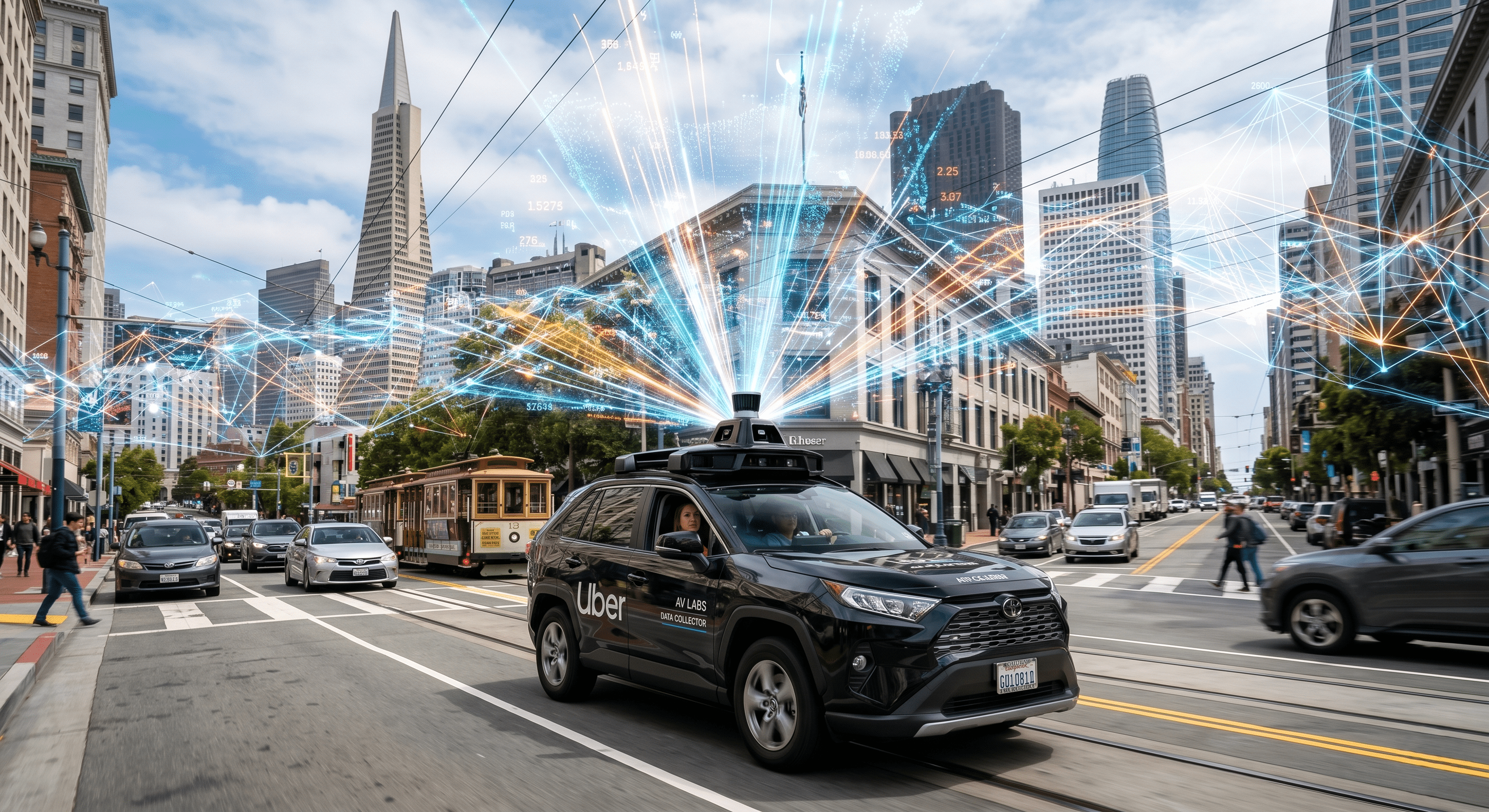
Uber has unveiled a long-term ambition that extends far beyond merely shuttling passengers from point A to point B. The company’s ultimate objective is to outfit its global network of human drivers’ personal vehicles with advanced sensor suites. By doing so, Uber aims to soak up invaluable, real-world physical data to feed the hungry artificial intelligence models of AV developers and other tech enterprises focused on physical-world scenarios.
This strategic masterstroke was recently detailed by Praveen Neppalli Naga, Uber’s Chief Technology Officer, during the TechCrunch StrictlyVC event in San Francisco. Instead of competing directly with hardware heavyweights, Uber is leveraging its greatest asset—its massive, distributed workforce—to solve the single most significant bottleneck in artificial intelligence today: high-quality, geographically diverse training data.
The Data Bottleneck in Autonomous Driving
To understand the genius of Uber’s pivot, one must look at the current state of autonomous vehicle development. The limiting factor for self-driving technology is no longer the underlying algorithms or the computing power. The true bottleneck is data acquisition.
Companies leading the AV space, such as Waymo, require vast amounts of localized data to train their models effectively. They need to understand edge cases—the rare, unpredictable events that happen on the road. For instance, an AI model might require specific data regarding how pedestrians behave at a particular school intersection in San Francisco at 3:00 PM on a rainy Tuesday. For a standalone AV company, gathering this hyper-specific information is an expensive logistical nightmare. They simply lack the capital and the infrastructure to deploy thousands of data-collection cars to every corner of every city.
This is exactly where Uber steps in. With millions of active drivers operating globally—from the dense, foggy streets of London to the sun-drenched, sprawling highways of Los Angeles—Uber possesses a geographic footprint that no single AV company could ever hope to replicate independently. If even a small fraction of Uber’s global fleet were transformed into rolling data-collection platforms, the sheer scale of the information gathered would entirely dwarf the proprietary datasets of any individual self-driving startup.
Inside AV Labs: The Precursor to a Global Grid
The journey toward this massive sensor grid is already underway through a nascent initiative known as AV Labs, which Uber quietly announced earlier this year. Currently, the AV Labs program relies on a small, dedicated fleet of sensor-equipped vehicles operated directly by Uber, kept entirely separate from its standard gig-worker driver network.
This dedicated fleet serves as a testing ground. Before Uber can begin bolting complex LiDAR, radar, and camera systems onto the personal Honda Civics and Toyota Camrys of its independent contractors, the company must deeply understand the hardware. Naga has emphasized that comprehending how these sensor kits integrate and function in varying climates and topographies is step one.
Furthermore, rolling out a decentralized sensor grid involves navigating a labyrinth of regulatory frameworks. Privacy laws, data ownership rights, and surveillance regulations vary wildly dramatically from state to state and country to country. Uber is currently laying the groundwork to ensure regulatory compliance, seeking absolute clarity from local governments regarding what these sensors capture, how the data is processed, and the legal implications of sharing this telemetry with third-party AI firms.
Becoming the Unavoidable 'Data Layer'
From a business perspective, positioning Uber as the definitive "data layer" for the autonomous transportation industry is a remarkably shrewd maneuver. Years ago, Uber abandoned its internal efforts to manufacture self-driving cars, a decision that co-founder Travis Kalanick publicly lamented as a massive strategic error. Industry observers openly speculated whether the proliferation of autonomous robotaxis would eventually render Uber’s human-dependent business model obsolete.
Instead, Uber has turned a potential existential threat into a lucrative symbiotic relationship. The company has already established partnerships with twenty-five different autonomous vehicle companies, including London-based Wayve. By aggregating this massive influx of sensor data, Uber is actively constructing an "AV Cloud." This cloud acts as a comprehensive, constantly updating library of labeled, real-world sensor data. Partner companies can query this database to train, refine, and stress-test their proprietary driving models.
Shadow Mode and the Future of AI Training
Perhaps the most fascinating technological aspect of this initiative is the implementation of "shadow mode" testing. Through the AV Cloud, Uber’s partners can run their developing autonomous algorithms against actual, historical Uber trips. This allows an AV company to simulate exactly how their self-driving software would have reacted to a real-world driving scenario without the inherent physical risks of putting an untested vehicle on public roads.
Publicly, Uber executives have stated that their primary goal is not necessarily to monetize this raw data directly, but rather to "democratize" access to it, lowering the barrier to entry for smaller AV startups that cannot afford massive data-collection fleets. However, given the undeniable commercial value of a proprietary, planet-scale data grid, this altruistic positioning may evolve. Uber has already executed equity investments in numerous AV players. By controlling the primary supply of premium training data, Uber secures incredible leverage over the entire autonomous sector—a sector that already relies heavily on Uber’s existing ride-hailing application to connect with consumer demand.
Conclusion
Uber’s grand vision represents a paradigm shift in how we view gig-economy networks. The millions of drivers navigating our cities are no longer just transportation providers; they are the scouts mapping the frontier of the artificial intelligence revolution. By conquering the data bottleneck, Uber ensures that even in a future dominated by self-driving cars, the algorithms powering those vehicles will have been trained on the human experiences of Uber drivers. Far from being rendered obsolete by the autonomous future, Uber is quietly positioning itself as the indispensable architect of it.



Comments
No comments yet. Be the first to share your thoughts!
Leave a Comment