Report: The Culture Clash at OpenAI – How Elon Musk’s Management Style Allegedly Stifled Foundational AI Research
Executive Summary
Recent legal proceedings have brought unprecedented transparency to the early days of one of the world's most influential artificial intelligence organizations. During ongoing litigation initiated by Elon Musk against OpenAI, current Chief Executive Officer Sam Altman provided extensive testimony detailing a profound clash of management philosophies. According to the statements provided in court, the aggressive, highly competitive management tactics famously employed by Musk caused significant cultural damage during his tenure at the San Francisco-based startup. This report analyzes the core of Altman’s testimony, focusing on the incompatibility of hyper-productivity mandates within a research environment that requires long-term psychological safety.
The Historical Context: A Silicon Valley Power Struggle
To fully comprehend the weight of the recent testimony, it is essential to revisit the geographical and historical origins of OpenAI. Founded in 2015 in the heart of San Francisco, California, the organization was initially conceived as a non-profit entity dedicated to developing artificial general intelligence for the benefit of humanity. Elon Musk co-founded the initiative alongside Sam Altman, Greg Brockman, and a core team of elite researchers.
However, by 2018, Musk had abruptly exited the organization. At the time of his departure, the official public relations narrative disseminated by OpenAI cited a preemptive effort to avoid potential conflicts of interest. The stated rationale was that Musk’s concurrent leadership at Tesla, which was aggressively expanding its own machine learning and autonomous driving capabilities, presented a structural conflict.
The current litigation and subsequent testimonies are effectively dismantling that original narrative. Instead of an amicable departure based on corporate restructuring, the court proceedings paint a picture of severe internal turbulence, driven primarily by fundamental disagreements over how to manage top-tier scientific talent.
Allegations of Destructive Management Practices
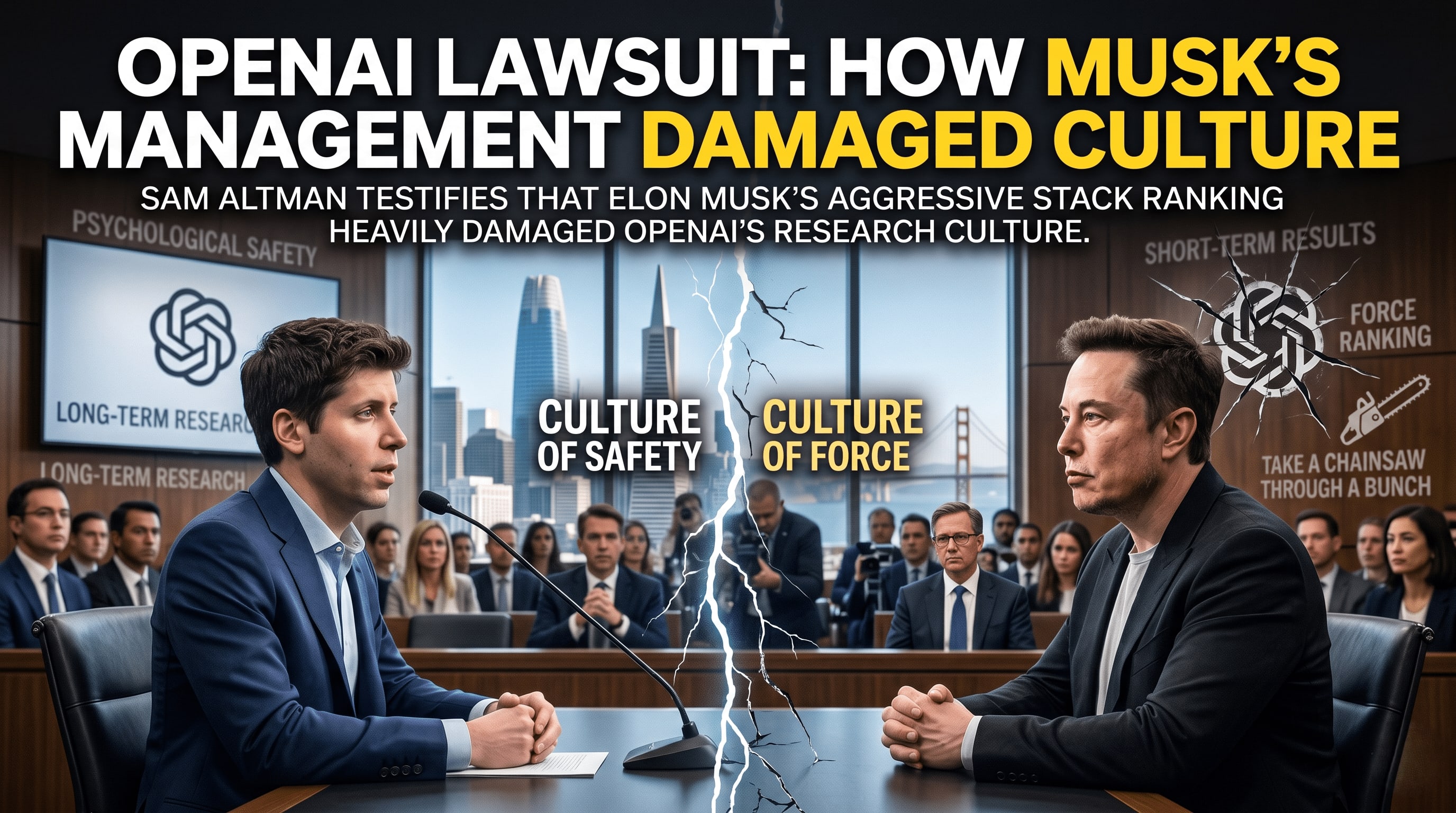
The focal point of Altman’s recent testimony centers on the specific management directives Musk attempted to implement prior to his exit. Altman reported to the court that Musk inflicted substantial damage on the foundational culture of the startup. The core of this damage stemmed from Musk’s demand for aggressive, forced performance rankings.
According to the testimony, Musk instructed OpenAI President Greg Brockman and former Chief Scientist Ilya Sutskever to rigorously evaluate and rank the laboratory’s researchers based strictly on their immediate accomplishments. Altman noted that the directive went far beyond a standard performance review; he described the mandate metaphorically as a demand to take a chainsaw to the roster, implying a requirement for severe and ruthless staff reductions based on these rankings.
This approach mirrors a controversial corporate management strategy often referred to as "stack ranking" or "rank-and-yank," a system notorious for fostering deeply toxic and fiercely competitive internal environments. While Altman acknowledged during questioning by his legal counsel that this high-pressure management style is exactly what the Tesla chief executive is globally recognized for, he argued vehemently that it was entirely the wrong framework for a nascent artificial intelligence laboratory.
The Necessity of Psychological Safety in AI Research
A critical component of the testimony addressed the fundamental differences between engineering execution and foundational scientific research. When questioned about the impact of Musk’s departure on employee morale, Altman articulated that the billionaire lacked a basic understanding of how to successfully operate a cutting-edge research facility.
Altman explained to the court that the nature of their work—pushing the boundaries of complex machine learning—required an environment deeply rooted in psychological safety. Researchers tasked with solving unprecedented, multi-year mathematical and computational problems need extended, uninterrupted periods to pursue complex hypotheses. They must be allowed to experiment, fail, and iterate without the looming threat of immediate termination.
The testimony highlighted that Musk’s operational philosophy demanded constant, short-term validation. The environment he allegedly sought to create operated on the premise that researchers must continuously prove their worth with immediate results, or face immediate dismissal. Altman stated categorically that such a high-anxiety, short-term framework simply could not sustain the kind of deep, exploratory research that eventually led to OpenAI’s global breakthroughs in generative artificial intelligence.
Broader Industry Implications and Geopolitical Context
The revelations from this trial reverberate far beyond the walls of a single San Francisco office. They touch upon a broader debate currently dominating the global tech ecosystem: the optimal way to manage highly specialized intellectual capital.
- Talent Retention in Competitive Hubs: In localized tech hubs like Silicon Valley, where the competition for top-tier machine learning engineers is fierce, organizational culture is a primary driver of talent retention. Environments that lack psychological safety frequently suffer from high turnover rates.
- Engineering versus Research: The testimony draws a sharp line between traditional software engineering—which can often be accelerated through intense, sprint-based management—and foundational scientific research, which requires patience and a high tolerance for short-term failure.
- The Evolving E.E.A.T Standard in AI: As artificial intelligence organizations strive to build systems characterized by Experience, Expertise, Authoritativeness, and Trustworthiness (E.E.A.T), the internal culture of these organizations is heavily scrutinized. A laboratory driven by fear and short-term survival metrics may inherently struggle to prioritize long-term safety and ethical alignment.
Conclusion
The ongoing legal dispute has inadvertently served as a highly publicized autopsy of OpenAI's early leadership dynamics. Sam Altman’s testimony systematically deconstructs the 2018 narrative of an amicable separation, replacing it with a detailed account of a profound cultural rejection. By rejecting the high-pressure, forced-ranking systems championed by Elon Musk, OpenAI made a definitive choice to prioritize psychological safety over relentless, short-term productivity demands. Whether this management philosophy is ultimately responsible for their current market dominance remains a subject of intense industry analysis, but the testimony clearly establishes that the battle for the future of artificial intelligence is as much about human resource management as it is about algorithmic complexity.

Comments
No comments yet. Be the first to share your thoughts!
Leave a Comment