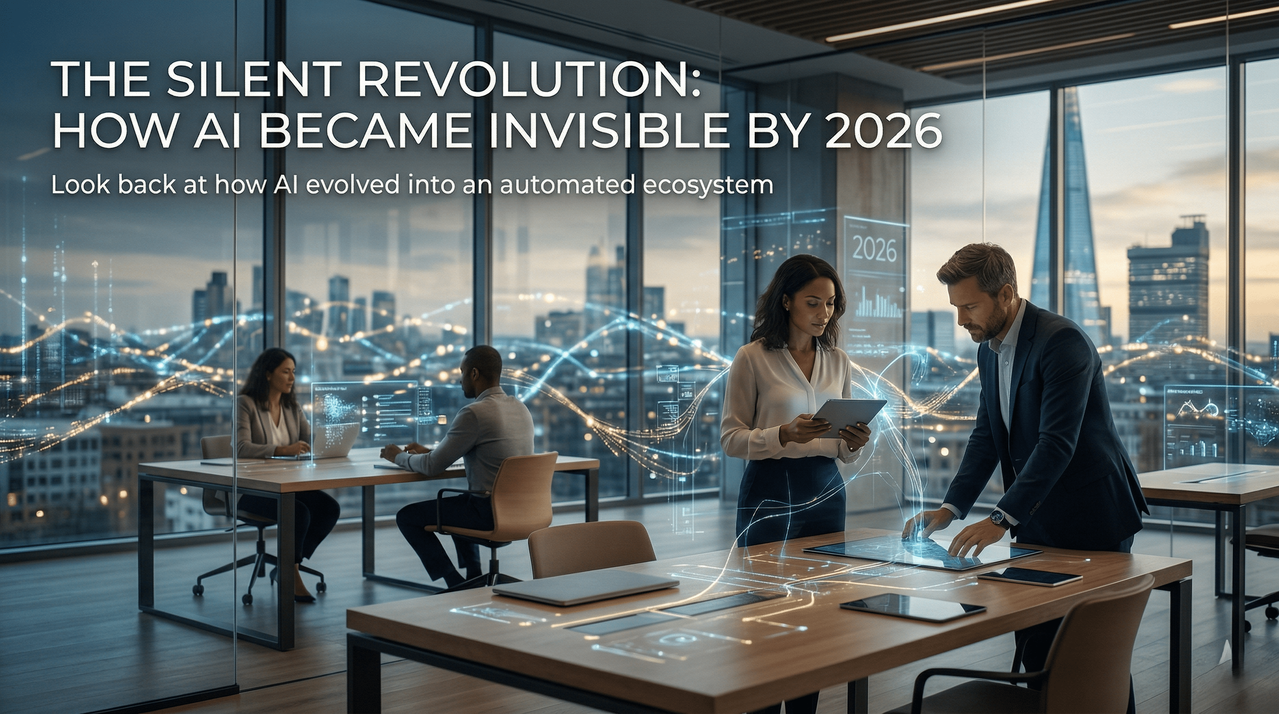
The Silent Revolution: How AI Became the Invisible Plumbing of Our World by 2026
There is a famous saying in technology circles: "The most profound technologies are those that disappear." They weave themselves into the fabric of everyday life until they are indistinguishable from it. Think about the internet. In the late 90s, we "logged on." We sat at a desk, waited for a dial-up tone, and entered a destination. Today, you don't "go" to the internet; you are simply connected. It is as ambient and essential as electricity or running water.
As we look back from the vantage point of 2026, it is clear that Artificial Intelligence has completed that exact same journey. What was once a flashy, talkative novelty in 2024 has become the silent, invisible plumbing of the global economy. The era of the "chatbot" is over; the era of the "autonomous agent" has arrived.
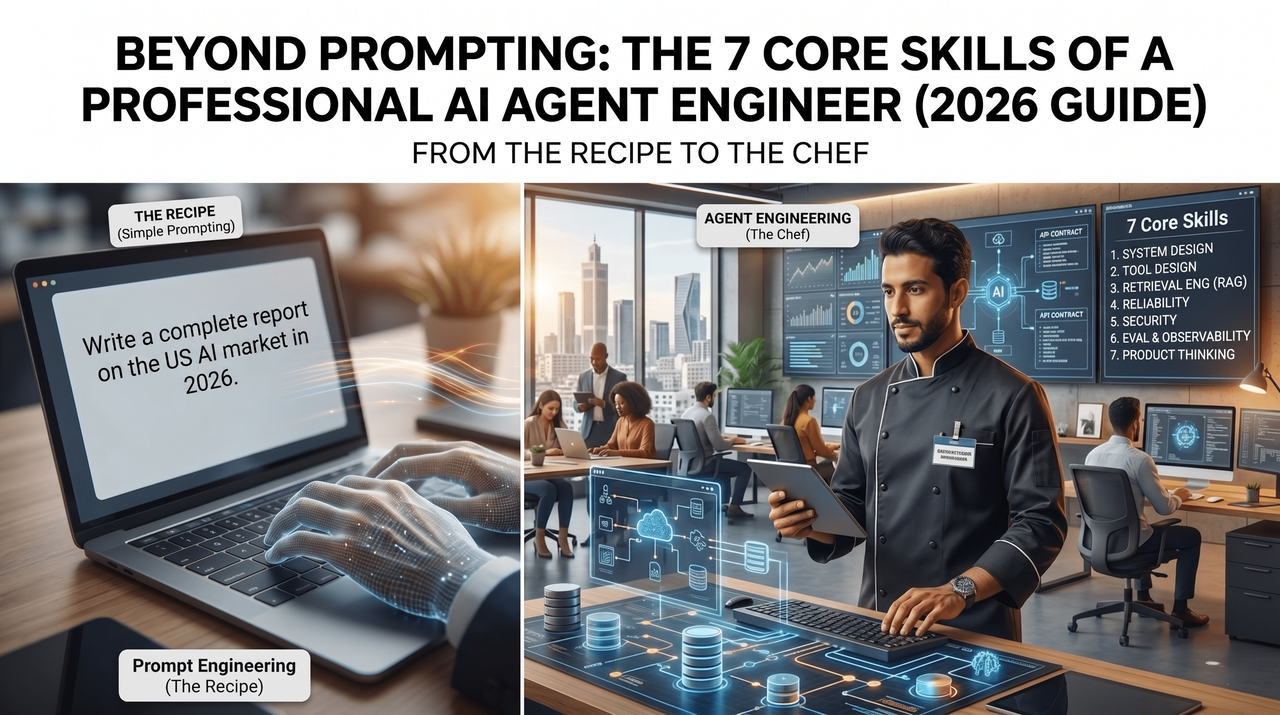
From Prompting to Delegating: The Great Shift
In 2024, the world was obsessed with "prompt engineering." We were teaching ourselves how to talk to machines, giving them step-by-step instructions: "Write this email," "Summarize this PDF," "Generate an image of a cat in a suit." It was a reactive, manual process.
By 2026, the paradigm shifted from instruction to delegation.
In the modern enterprise environment, users no longer micro-manage AI. Instead, they delegate outcomes. Instead of asking an AI to write a series of emails, a manager might simply say, "Handle the Q3 sales review." The underlying system doesn't just draft text; it accesses CRM data, analyzes regional performance, coordinates with team calendars, and generates a comprehensive workflow. This is the move from "Human-in-the-loop"—where a person must supervise every single step—to "Human-on-the-loop," where the human only needs to audit the final result.
The Anatomy of the Autonomous Agent
What made this leap possible? It was the evolution of the basic chatbot into a sophisticated Autonomous AI Agent. Unlike the tools of the early 2020s, these agents are proactive and goal-oriented. They possess four core components that allow them to function without "babysitting":
- Profiling: The agent is given a specific "identity" and job description, understanding its role within a company's hierarchy.
- Memory: A sophisticated "brain" that tracks past interactions, company preferences, and long-term project goals.
- Planning: The ability to take a complex, "scary" goal and break it down into a logical to-do list.
- Action: The capability to "get its hands dirty" by connecting to other software—API integrations that allow it to move data across Sheets, Slack, Outlook, and specialized industry tools.
The New Digital Workplace: Agents in the Wild
This isn't theoretical; it is deeply embedded in the tools we use daily. In the world of 2026, your calendar isn't just a grid; it’s a living entity. While basic assistants like Microsoft’s Co-pilot handle the basics, invisible agents like Reclaim.ai work in the background. They "defend" your deep-work time and reshuffle meetings based on priority without you ever having to lift a finger.
In data analysis, the barrier to entry has evaporated. In 2024, you needed to be a "wizard" of Excel formulas. Today, Google Gemini has turned every Google Sheets user into a data analyst. By asking questions in plain English, the AI handles the complex computational logic behind the scenes.
Even the creative gap is closing. In design platforms like Figma and Adobe, "silent co-designers" now automate the repetitive tasks of synthesizing research or mocking up layouts. More importantly, they have closed the "design-to-code" gap, automatically generating the backend requirements that developers need, effectively doubling the speed of product cycles.
The Risks: Shadow AI and the "Third Identity"
However, this invisible power comes with a steep price. As AI became easier to use, it became harder to govern. We are currently facing a crisis of "Shadow AI."
Recent data suggests that a staggering 77% of employees have admitted to pasting sensitive company data into unapproved AI tools. Because these tools are so effective, employees use them regardless of IT policy. This has forced a complete rethink of digital security.
We are no longer just managing human accounts and machine accounts. We have entered the era of the "Third Identity." An AI agent has the access privileges of a human but operates at the lightning speed of a machine. Crucially, it lacks the "moral compass" or the "gut feeling" that tells a human when a certain data transfer is a bad idea.
The Regulatory Response: The Bulletproof Black Box
This "accountability gap" has led to intense legislative pressure, most notably the EU AI Act. By 2026, companies are required to maintain an unchangeable, automated audit trail for every action an agent takes. We call this the "bulletproof black box." If an agent makes a mistake, there must be a record of exactly what data it saw, what logic it used, and what prompt it followed. Accountability is the new currency of the AI era.
The 80/20 Partnership: A New Model for Success
Despite the hype, the road to 2026 was littered with failures. Approximately 40% of AI agent projects were shut down because they were too expensive and failed to deliver a clear Return on Investment (ROI).
The companies that succeeded were those that stopped trying to "replace" humans and started focusing on a partnership model. This is the 80/20 workflow:
- The 80% (AI): The foundational "heavy lifting"—the research, the initial drafts, the data cleaning, and the logistical coordination.
- The 20% (Human): The "irreplaceable" elements—strategic judgment, creative taste, emotional intelligence, and the final polish that turns "good" into "great."
Final Thoughts: The Foundation for Tomorrow
As we look at the landscape of 2026, the three big lessons for any organization are clear:
- Focus on Workflow, Not UI: It’s not about how the AI looks; it’s about how it connects.
- Manage Actions, Not Just Access: You must govern what an AI does, not just what it sees.
- Embrace Automation at Scale: You cannot manage AI-speed output with human-speed processes.
Just as the internet provided a foundation for decades of innovation, AI has now become our new, invisible foundation. The question is no longer "Will AI change my job?" but rather "What will I build now that the plumbing is finally finished?"
Author’s Note: This report was synthesized from the observed trends of 2024-2025 and the technological milestones reached in early 2026. While the technology is "invisible," the human responsibility to direct it has never been more visible. Keep your hands on the wheel, even if the car is driving itself.

Comments
No comments yet. Be the first to share your thoughts!
Leave a Comment