

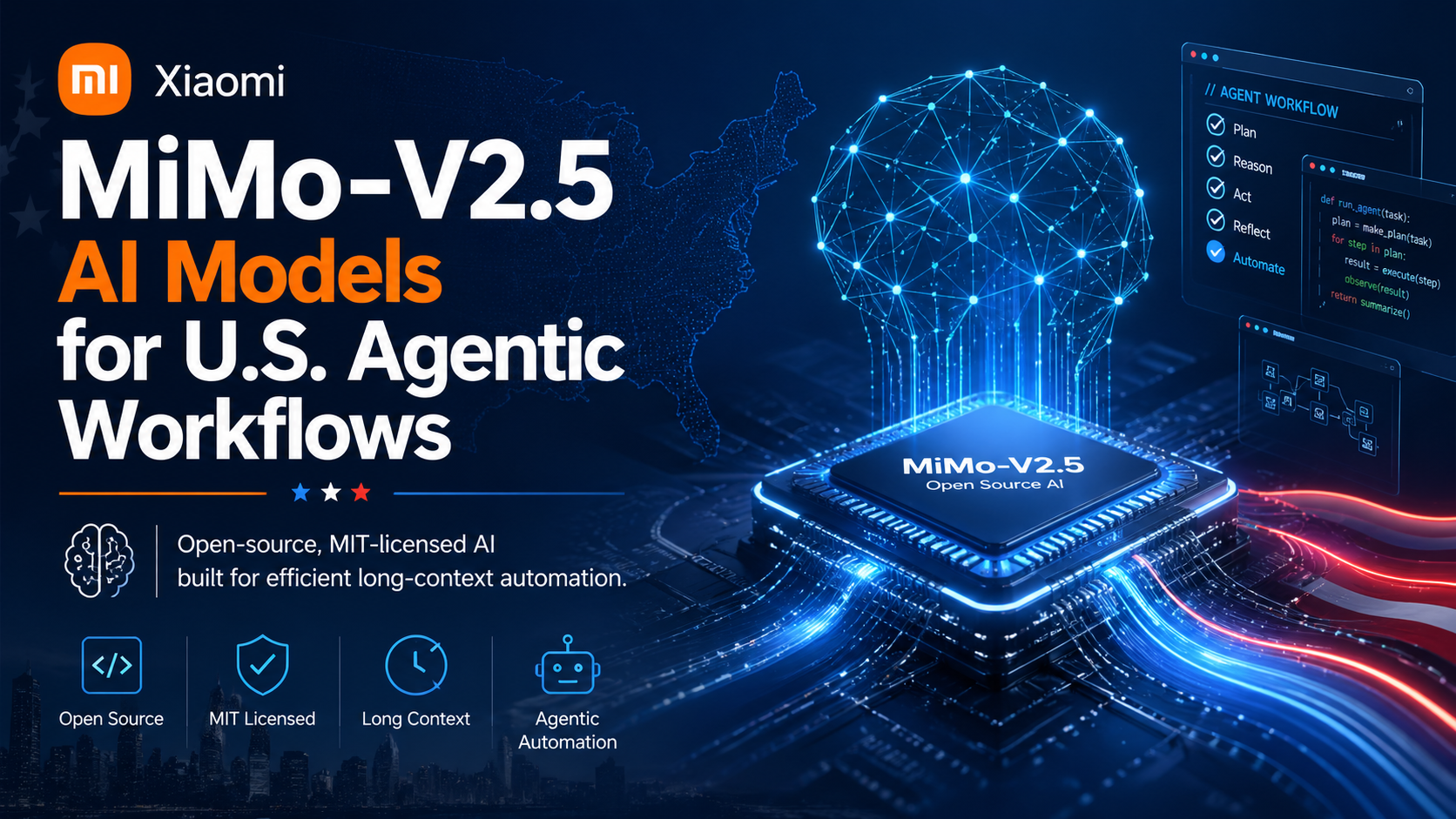
Xiaomi MiMo-V2.5 and MiMo-V2.5-Pro: Open-Source AI Models Built for Affordable Agentic Workflows in the U.S. Market
The open-source artificial intelligence market is entering a new phase, and Xiaomi is becoming one of the most surprising companies pushing that shift forward. Known globally for smartphones, electric vehicles, smart home devices, and consumer electronics, Xiaomi is now positioning itself as a serious player in advanced AI infrastructure with the release of Xiaomi MiMo-V2.5 and Xiaomi MiMo-V2.5-Pro.
These models are designed for developers, startups, enterprise teams, and AI builders who need powerful large language models without the high recurring costs often attached to closed-source frontier systems. For the U.S. market, where businesses are increasingly experimenting with AI agents, coding assistants, autonomous workflows, and private cloud deployments, Xiaomi’s new MiMo models may offer an important combination: strong performance, long-context reasoning, permissive licensing, and competitive pricing.
A New Open-Source Challenger in Agentic AI
The most important feature of Xiaomi MiMo-V2.5 and MiMo-V2.5-Pro is not simply that they are large AI models. Their real significance comes from how they are designed to perform in agentic workflows.
Agentic AI refers to systems that do more than answer questions. These systems can plan, use tools, execute tasks, manage long workflows, interact with software, write code, schedule actions, organize information, and complete multi-step objectives. In practical terms, an agentic model may help run marketing operations, automate email workflows, generate and publish business content, assist developers with codebases, or manage internal productivity tasks.
According to Xiaomi’s benchmark claims, MiMo-V2.5 and especially MiMo-V2.5-Pro are highly efficient on agentic “claw” tasks. These tasks are associated with frameworks where AI agents operate through tool calls and external environments. The models reportedly deliver strong task success while consuming fewer tokens than many leading proprietary systems.
That efficiency matters. In the United States, more AI platforms are moving toward usage-based billing. Instead of unlimited access, businesses may be charged based on token consumption. For AI agents, this can become expensive because a single long-horizon task may require many thousands or even millions of tokens. A model that can complete complex work with fewer tokens can reduce operating costs significantly.
Why Token Efficiency Matters for U.S. Businesses
For American startups, software teams, agencies, and enterprise departments, AI adoption is no longer just about performance. Cost control is becoming equally important.
Many companies first tested AI through chat interfaces or subscription-based tools. But as AI becomes embedded into real business operations, usage becomes heavier and more unpredictable. Coding agents, customer service agents, internal research assistants, and workflow automation systems can run continuously. When pricing is token-based, poor efficiency can turn a promising AI project into an expensive operational burden.
This is where Xiaomi MiMo-V2.5-Pro becomes especially interesting. The Pro model is described as leading the open-source field in claw-style benchmarks, with a strong success rate while using a relatively low number of tokens per trajectory. If those results hold up in real-world deployments, U.S. organizations could use MiMo-based systems to reduce the cost of long-running AI agents.
For budget-conscious AI teams, this could be a practical advantage. A model that performs well while using fewer tokens allows companies to experiment more freely, scale internal AI tools, and avoid overdependence on premium closed models.
MIT License: A Major Advantage for Enterprise Adoption
One of the strongest selling points of Xiaomi MiMo-V2.5 is its MIT License. In the open-source software world, the MIT License is widely respected because it allows broad commercial use with minimal restrictions.
For U.S. companies, this matters for several reasons.
First, businesses can use the model commercially without requesting special approval. Second, developers can fine-tune the model on proprietary data. Third, companies can build derivative applications and deploy them internally or externally. Fourth, the license reduces uncertainty compared with more restrictive “open weight” licenses that may include revenue limits, usage restrictions, or unclear commercial terms.
This permissive licensing strategy makes MiMo-V2.5 more attractive to software vendors, enterprise AI labs, independent developers, and startups that want control over their AI stack. It also supports private deployment, which is important for companies dealing with sensitive data, regulated workflows, or internal intellectual property.
MiMo-V2.5 vs. MiMo-V2.5-Pro
Xiaomi has released two models aimed at different types of users.
MiMo-V2.5 is the broader multimodal model. It is designed to process and reason across different input types, including text, visual, and audio-related data. This makes it useful for general-purpose AI applications, multimodal assistants, document analysis, media understanding, and consumer-facing tools.
MiMo-V2.5-Pro, on the other hand, is built for complex agentic tasks, software engineering, and long-horizon coherence. This means the model is designed to maintain consistency across many steps, tool calls, and instructions. For developers working on autonomous coding agents, workflow agents, or complex technical assistants, the Pro version may be the more relevant option.
The Pro model reportedly supports demanding tasks such as compiler construction, video editor development, and engineering optimization workflows. These examples suggest that Xiaomi is not positioning MiMo-V2.5-Pro as a simple chatbot. Instead, it is presenting the model as an AI engine for real work.
Architecture Designed for Scale and Efficiency
The MiMo-V2.5 family uses a Sparse Mixture-of-Experts architecture. In simple terms, this means the model contains a very large number of total parameters, but only a smaller portion is active during a given inference task.
This approach can make large models more efficient. Instead of activating the full model every time, the system routes work to the most relevant “experts.” For users, the goal is to achieve strong performance without the full cost of running every parameter at once.
The base MiMo-V2.5 model reportedly uses a 310-billion-parameter architecture with a smaller active footprint. MiMo-V2.5-Pro is described as even larger, with a trillion-parameter-class design and a higher active parameter count. The purpose of this scale is to support deeper reasoning, better long-context performance, and more reliable execution across multi-step tasks.
Another key feature is the long context window. Xiaomi emphasizes native support for up to one million tokens. For U.S. businesses, this could be valuable in areas such as large codebase analysis, legal document review, enterprise knowledge search, financial research, product documentation, and multi-hour autonomous agent workflows.
A Strategic Option for U.S. Developers
Although Xiaomi is a Chinese company, the open-source nature of the MiMo release gives U.S. developers more deployment flexibility. Companies that are cautious about using foreign-hosted APIs may choose to download the model weights and run them on domestic infrastructure, private cloud systems, or controlled virtual private cloud environments.
This is particularly relevant for U.S. enterprises that need to manage compliance, privacy, vendor risk, and data governance. Running an open-source model locally can reduce exposure to third-party API data handling, depending on how the system is deployed and secured.
However, companies should still evaluate cybersecurity, licensing, supply chain, and compliance questions before production use. Open-source access is powerful, but enterprise deployment should include proper model evaluation, security review, data protection controls, and monitoring.
Why Xiaomi’s AI Push Matters
Xiaomi’s move into open-source AI is not happening in isolation. The company has built a large ecosystem across phones, connected devices, operating systems, smart homes, and electric vehicles. That hardware-software ecosystem gives Xiaomi a broad testing ground for AI agents that interact with real-world devices and services.
This is one reason the MiMo release feels strategically important. Xiaomi is not only releasing a model for research attention. It appears to be building infrastructure for a future where AI agents operate across apps, devices, vehicles, homes, and enterprise systems.
For the broader AI market, this increases pressure on closed-source providers. If open-source models continue improving while offering lower cost and flexible licensing, more businesses may adopt hybrid AI strategies. Instead of relying on one proprietary model, companies may combine open models for high-volume workflows with premium closed models for specialized tasks.
Conclusion: A Cost-Efficient Open-Source Model for the Agentic AI Era
Xiaomi MiMo-V2.5 and MiMo-V2.5-Pro represent a serious step forward for open-source AI, especially in agentic and long-context workloads. Their combination of MIT licensing, strong benchmark positioning, large context capacity, and token efficiency could make them attractive to U.S. developers and enterprises seeking lower-cost alternatives to proprietary frontier models.
For American businesses, the key question is not whether Xiaomi can compete in AI branding. The real question is whether MiMo can deliver reliable performance in production environments. If the models perform as claimed, they could become valuable tools for coding agents, workflow automation, enterprise research, technical documentation, and private AI deployments.
The AI market is moving from simple chatbots to persistent digital workers. In that world, cost, control, licensing, and efficiency matter as much as raw intelligence. Xiaomi MiMo-V2.5 and MiMo-V2.5-Pro appear designed for exactly that future.


Comments
No comments yet. Be the first to share your thoughts!
Leave a Comment