
Z.ai’s GLM-5.1 Discount Looks Like a Defensive Move Against DeepSeek’s Pricing Pressure
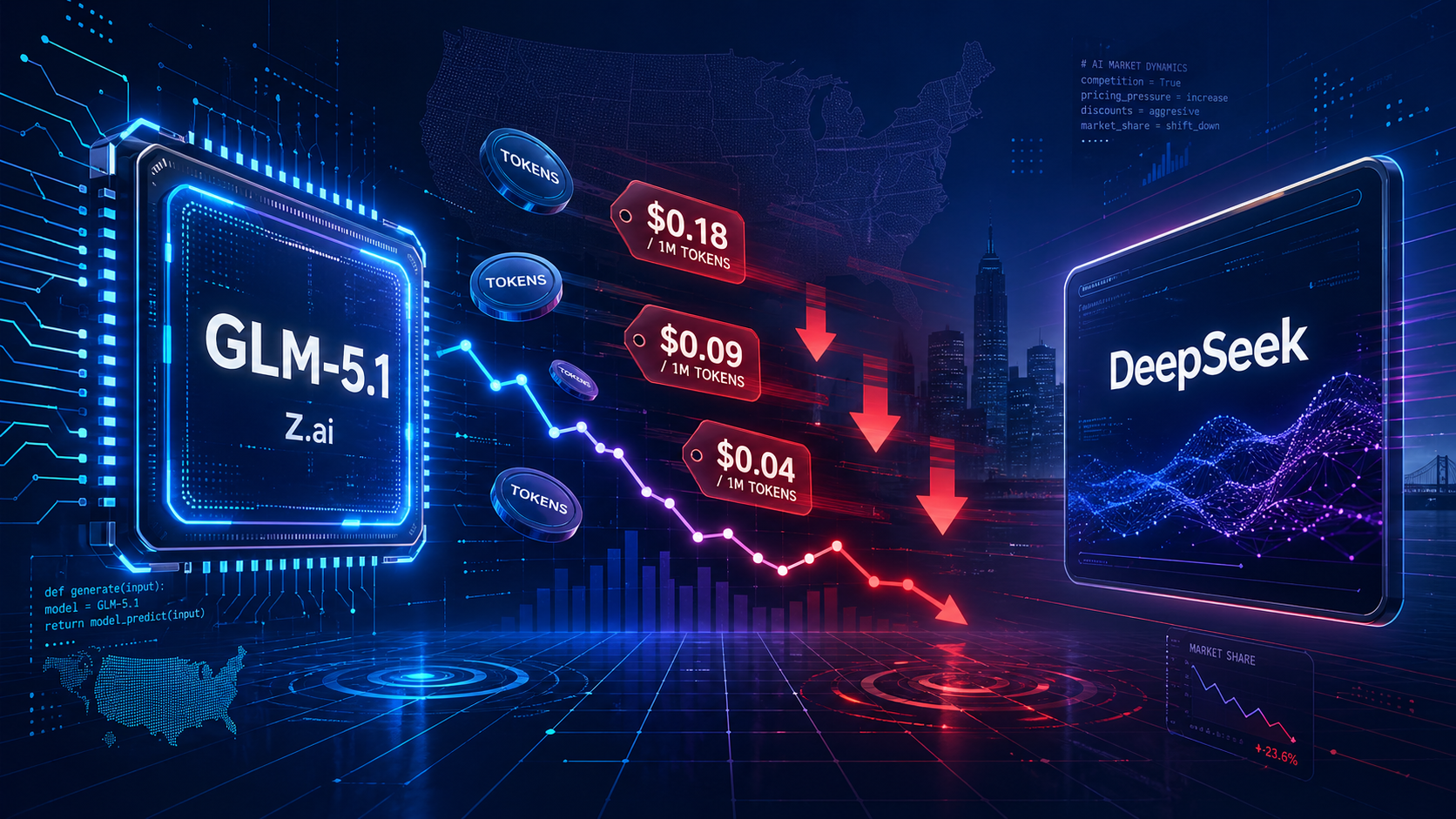
Z.ai’s latest pricing adjustment for its GLM-5.1 and GLM-5-Turbo models looks less like a simple customer reward and more like a strategic response to growing pressure from DeepSeek. The company is offering a temporary token consumption benefit through June 30 for members of its GLM Coding Plan, giving users access to GLM-5.1 and GLM-5-Turbo at a 1x token consumption rate during the promotional window.
On the surface, this may sound like a routine limited-time offer. In reality, it appears to reveal something much deeper about the current artificial intelligence market: pricing has become one of the most important competitive weapons in the AI race.
For developers, startups, and enterprise teams in the United States, the cost of using AI models is no longer a minor technical detail. It directly affects which tools get integrated into products, which platforms become part of daily workflows, and which vendors earn long-term loyalty. Z.ai’s move comes at a time when AI users are becoming more selective, more price-aware, and more willing to switch providers when a better balance of performance and cost becomes available.
Z.ai Is Trying to Protect Its Developer Base
Z.ai, backed by Zhipu AI, has been working to position its GLM model family as a serious option for coding, automation, and advanced AI development. GLM-5.1 and GLM-5-Turbo are part of that effort, especially for users who want powerful coding assistance without relying only on Western AI companies.
However, model quality alone is no longer enough to guarantee user loyalty. Developers compare latency, accuracy, context handling, coding ability, API stability, and, most importantly, cost. When teams build software around a model, every token matters. A small pricing difference can become a major monthly expense once usage scales.
That is why the temporary 1x token consumption benefit matters. It is not a breakthrough feature. It does not change the architecture of the model or introduce a new technical capability. Instead, it lowers the effective cost for a specific group of users and gives them a reason to keep using Z.ai’s ecosystem.
This kind of pricing adjustment often happens when a company wants to prevent users from drifting toward competitors. It gives current customers a short-term reason to stay while the company works to strengthen its product, refine its pricing structure, or prove that its models deliver enough value to justify future costs.
DeepSeek Has Changed AI Pricing Expectations
The main reason this update feels defensive is the rise of DeepSeek. DeepSeek has had a major impact on how developers and businesses think about AI model pricing. By offering strong performance at highly competitive rates, DeepSeek has changed expectations across the market.
Before this shift, many AI companies could compete mainly on performance claims, benchmark results, and brand reputation. Today, that strategy is harder to sustain. Users want to know how much a model costs per useful task. They want to know whether the model can solve real coding problems, generate reliable outputs, and fit inside a practical budget.
For U.S. developers and AI-focused startups, this matters a lot. Many teams are building products with limited funding, tight margins, and constant pressure to control infrastructure expenses. If one model offers acceptable performance at a much lower cost, it becomes difficult for higher-priced competitors to defend their position unless they can clearly prove superior results.
This is the pressure Z.ai appears to be facing. The company may describe the token benefit as a limited-time incentive, but the market context suggests it is also a retention strategy. DeepSeek has made cheaper AI feel normal, and once users become used to lower pricing, it becomes much harder for other model providers to raise prices without resistance.
Why Temporary Discounts Matter in AI
Temporary discounts are common in software markets, but in AI they carry extra meaning. AI usage is measured continuously through tokens, API calls, and compute consumption. That means the cost is not just a one-time subscription fee. It grows with activity.
For a developer testing a model, a discount may encourage experimentation. For a company already using the model in production, a discount may reduce operational costs enough to delay switching. For Z.ai, that delay is valuable. Keeping users inside the platform gives the company more time to improve performance, strengthen reliability, and build deeper customer dependence.
Once a developer integrates a model into a workflow, switching is not always effortless. Prompts may need to be rewritten. Outputs may behave differently. Evaluation pipelines may need to be updated. Teams may need to test safety, reliability, and compatibility again. Because of that, AI companies have a strong incentive to keep users active before they seriously consider alternatives.
Z.ai’s temporary token break can be understood through that lens. It reduces the immediate reason to leave. It also sends a message that the company understands pricing concerns and is willing to respond.
The China AI Market Is Becoming More Aggressive
The competitive pressure is especially intense in China’s AI market, where companies are using price cuts, open-weight releases, benchmark comparisons, and developer promotions to gain attention. Zhipu AI has been one of the major players trying to compete in this fast-moving environment, but the market has become increasingly unforgiving.
When companies spend heavily on training advanced models, they eventually need to monetize those investments. That usually means subscriptions, paid API access, usage tiers, and premium plans. But monetization becomes difficult when competitors are pushing prices down.
This creates a difficult balance. If Z.ai prices too high, it risks losing developers to cheaper alternatives. If it prices too low, it may damage margins and make it harder to support long-term model development. The temporary nature of the GLM-5.1 and GLM-5-Turbo benefit suggests the company is trying to manage that tension carefully.
Rather than permanently lowering prices, Z.ai is offering a time-limited concession. That allows the company to protect users in the short term without fully committing to a new pricing baseline.
U.S. Developers Should Watch This Trend Closely
Although Z.ai and DeepSeek are closely tied to the Chinese AI ecosystem, the pricing battle has global consequences. U.S. developers, AI startups, software companies, and enterprise buyers are all affected by the broader shift toward cheaper, more capable models.
The AI market is no longer defined only by the biggest brand names. Open-weight models, lower-cost APIs, and international competitors are giving users more choices. As a result, American companies evaluating AI tools are likely to become more demanding. They will expect better performance, lower prices, more flexible usage plans, and clearer value.
This is especially important for businesses building AI-powered coding tools, customer support systems, research assistants, data analysis platforms, and automation products. The model provider they choose can influence both product quality and long-term cost structure.
Z.ai’s pricing move is a reminder that AI model selection should not be based only on hype. Teams should evaluate models based on real-world performance, total cost, reliability, integration effort, and vendor stability.
Price Is Now Part of the Product
The biggest lesson from Z.ai’s temporary GLM-5.1 and GLM-5-Turbo discount is simple: in artificial intelligence, price is now part of the product.
A model can be powerful, but if it is too expensive for frequent use, developers may avoid it. A model can perform well on benchmarks, but if a competitor offers similar results at a lower cost, users may migrate. A company can have strong technology, but if its pricing strategy feels out of step with the market, it risks losing momentum.
DeepSeek’s influence has made this reality harder to ignore. By changing what users expect to pay for capable AI, DeepSeek has forced competitors to respond. Z.ai’s token consumption benefit appears to be one such response.
For now, the discount may help Z.ai retain GLM Coding Plan members and keep developers engaged with GLM-5.1. But temporary promotions are not a permanent solution. If the AI market continues moving toward lower-cost, high-performance alternatives, Z.ai will need more than short-term incentives. It will need to prove that its models offer lasting technical and economic value.
The broader message is clear for the entire AI industry. Performance still matters, but pricing now matters just as much. In a market shaped by aggressive competition, every token discount tells a story about pressure, retention, and the battle for developer loyalty.


Comments
No comments yet. Be the first to share your thoughts!
Leave a Comment